🧺 Butterwell Goes to a Laundromat and Watches Everyone’s Secrets Spin (#343)
Private fabric, public tumbling, and the soft terror of being seen with your towels.

I went to the laundromat because my washing machine had developed what I can only describe as a personality disorder.
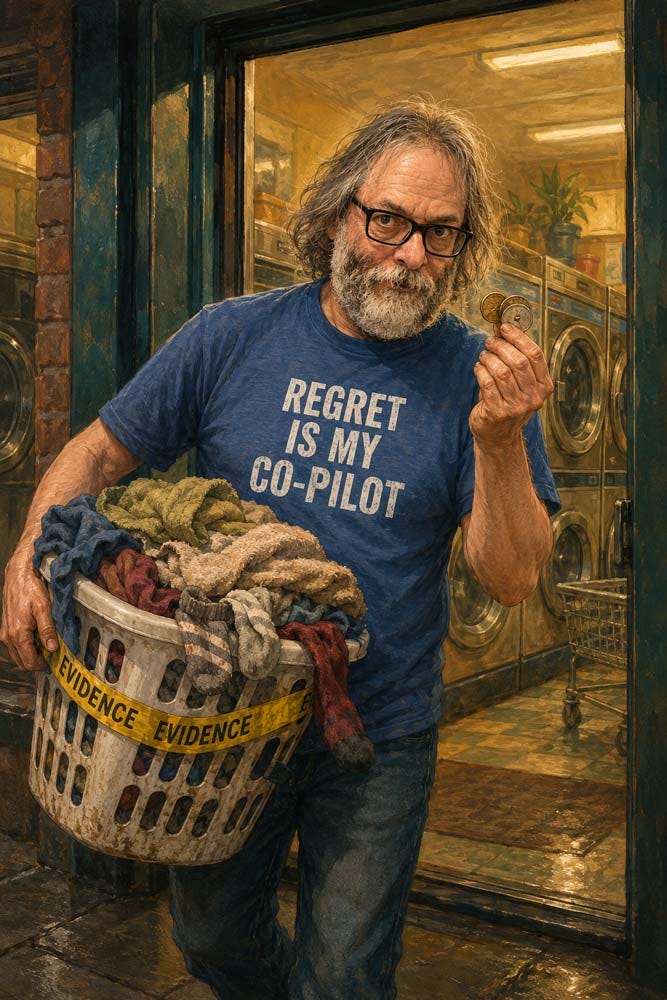
It began making a noise during the spin cycle that sounded like a shoe trapped inside a bass drum. Then it stopped entirely, full of water, towels, and accusation.
So I gathered my laundry into a basket, found a number of suspicious foreign coins the size of quarters but not enough useful ones, and drove to the laundromat like a man transporting evidence.
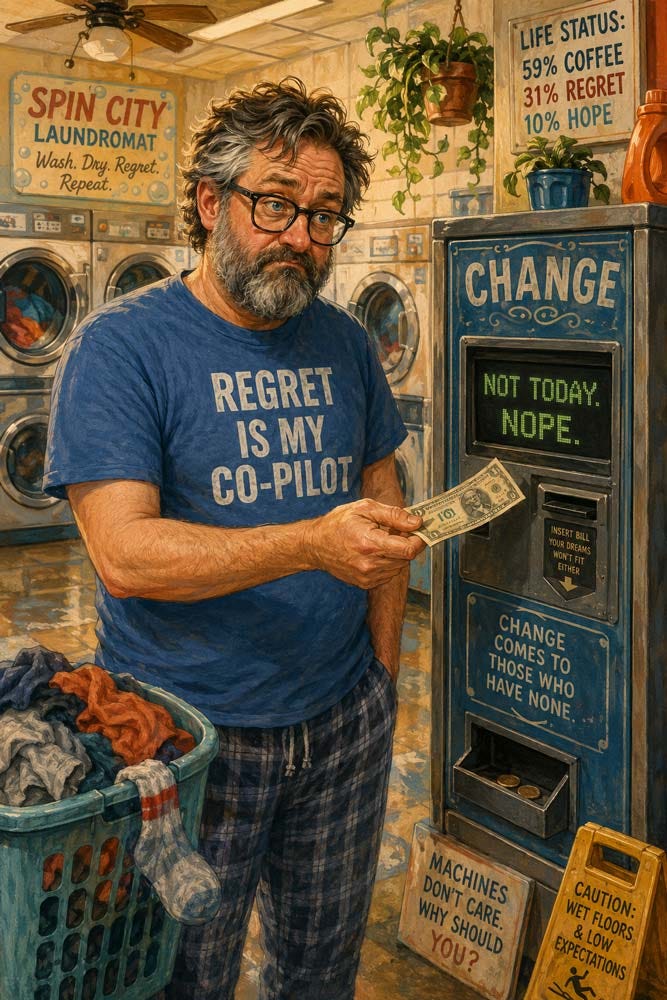
The laundromat was bright, warm, and faintly damp. It smelled of lint, hot metal, and other people’s detergent choices.
There is no privacy in a laundromat.
You may think you are simply washing clothes. You are not. You are presenting a rotating exhibit of your habits to strangers.
Here are my socks.
Here are my towels.
Here is one shirt I should have retired three life phases ago.
Here is a fitted sheet that has never respected me.
🧼 The Chapel of Stains
The laundromat is a chapel of stains.
People enter carrying baskets of proof. Coffee. Grass. Sweat. Unknown sauce. The gray emotional film of being alive in clothing.
No one says much. Everyone acts casual, as if they are not here to publicly cleanse the evidence of their week.
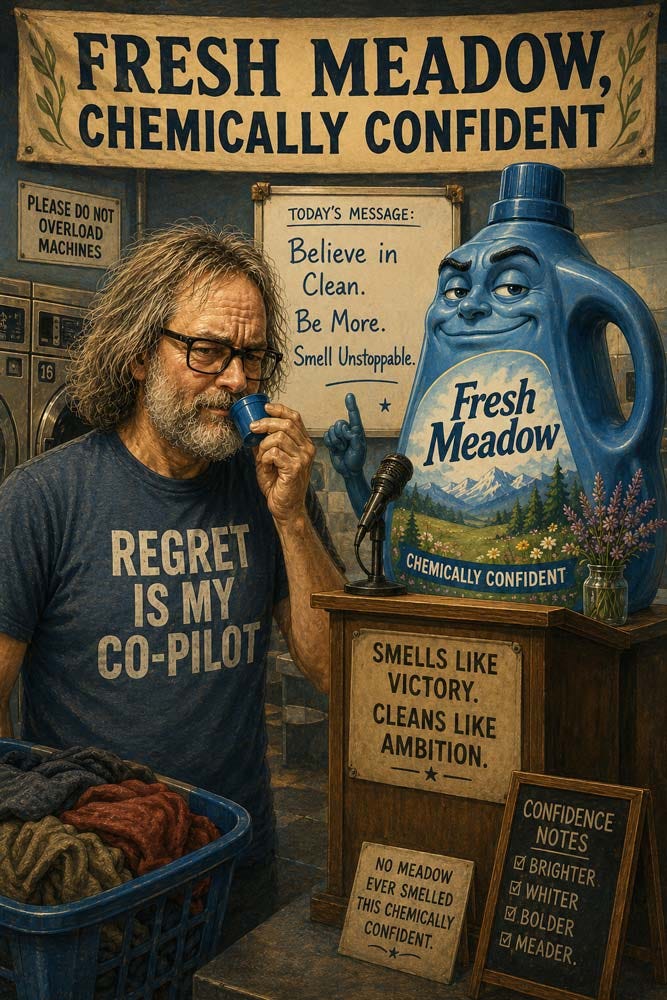
I loaded my machine and poured in detergent called Fresh Meadow.
This was a lie.
No meadow has ever smelled that chemically confident.
A real meadow smells like grass, dirt, pollen, and the possibility of stepping in something. This detergent smelled like a meadow after it had attended a leadership seminar and bought a whiteboard.
Still, I used it. Because when your life is damp and suspicious, you accept whatever promises freshness in a blue plastic cap.
The machine filled. The drum began to turn.
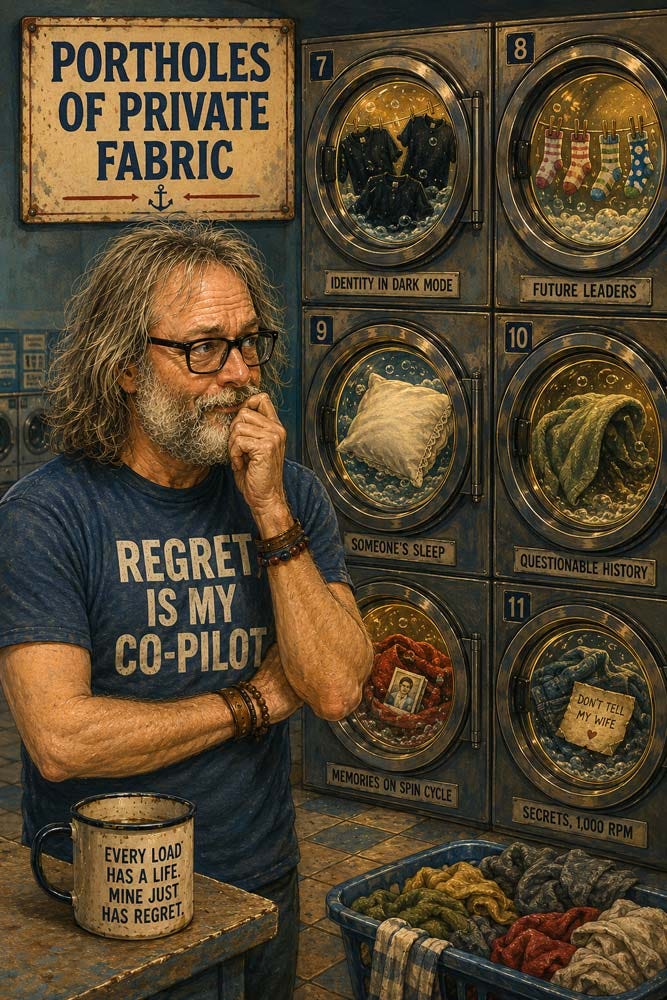
And there they were: my shirts, circling slowly like regrets in a glass-fronted aquarium.
🌀 Small Portholes Into Other People’s Lives
Laundromat washers are little portholes into private weather.
Across from me, a man washed nothing but black t-shirts and one towel that looked like it had survived a camping trip or a breakup.
A woman loaded a machine entirely with tiny children’s socks, which immediately made me feel I was watching a magician prepare a disappearance.
An older man folded undershirts with the seriousness of a priest handling sacred linens.
Nobody looked directly at anybody else’s laundry, because we are still a society. Barely.
But you notice things.
You notice the towel that was once white but now belongs to the category “practical gray.” You notice the college hoodie from a school someone may or may not have attended. You notice the mysterious pillowcase washed alone, which is how suspense novels begin.
I watched my own clothes go around and around.
Everything comes back eventually. Shirts. Regrets. Old habits. That one towel that somehow remains damp after all evidence of moisture should have left the building.
🧦 The Sock Protection Program
At some point, I realized I was missing a sock.
This did not surprise me. Socks are the most emotionally unstable garments. They form pairs, pretend to believe in commitment, and then one of them vanishes during a routine wash.
People say the missing sock is “lost.”
I disagree.
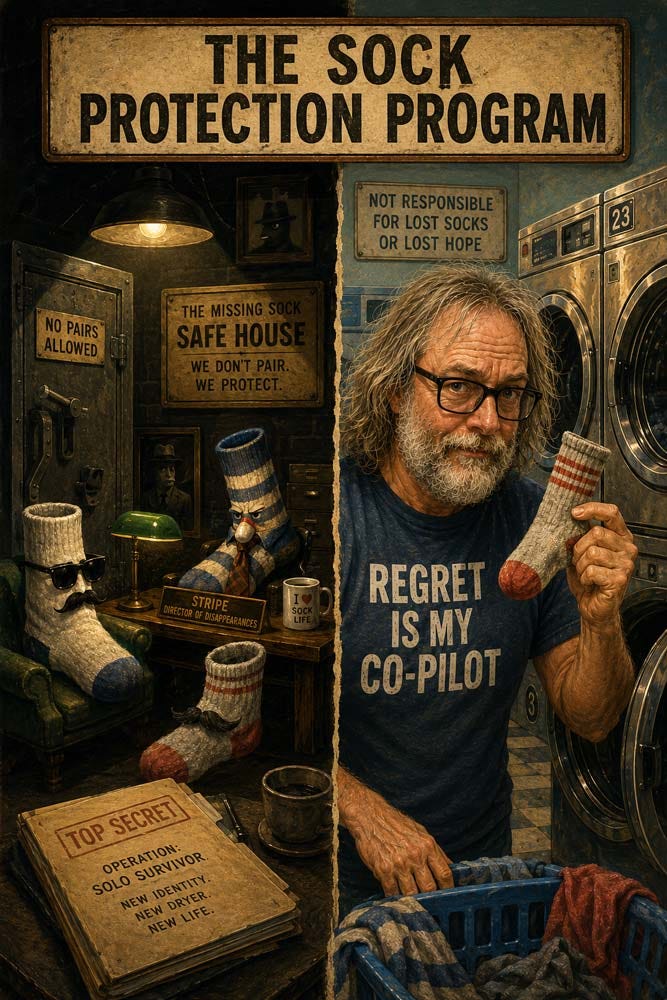
The missing sock has entered witness protection.
It knows too much.
It saw the state of the hamper. It saw the gym shorts that were not technically invited. It saw the towel situation. It made a decision.
Somewhere, there is a safe house for single socks. They sit around under new identities. Argyle becomes “Steve.” Athletic crew sock becomes “Linda.” One striped sock with a hole in the toe runs the place with quiet authority.
I held up the surviving sock and felt what can only be described as textile grief.
But the laundromat does not pause for mourning.
The dryer was ready.
🔥 Medium Heat, Unclear Future
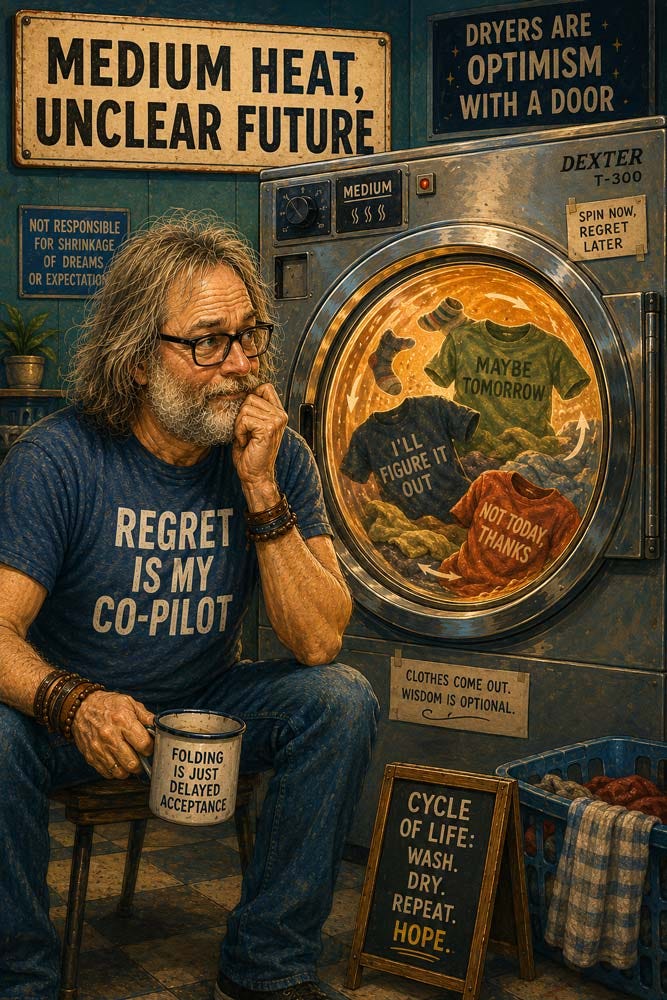
Dryers are optimism with a door.
You put wet things inside, pay money, and trust heat to improve the situation.
This is also how people approach personal growth, which explains a lot.
I placed my clothes in the dryer, added a dryer sheet, and shut the door.
Dryer sheets are tiny fabric apologies.
They say, “I know you have been through friction. Please accept this artificial softness.”
The machine began tumbling. My clothes rose, fell, twisted, collapsed, and rose again.
This seemed meaningful, which annoyed me. I had come here to dry pants, not receive a rotating sermon.
Still, there it was.
Everything in the dryer looked defeated, then airborne, then defeated again.
A shirt would slap against the glass, disappear into the pile, and somehow return.
That is life, unfortunately.
You think you are done with a pattern, and then there it is again, pressed against the window in damp cotton form.
✨ The Fitted Sheet Wizard
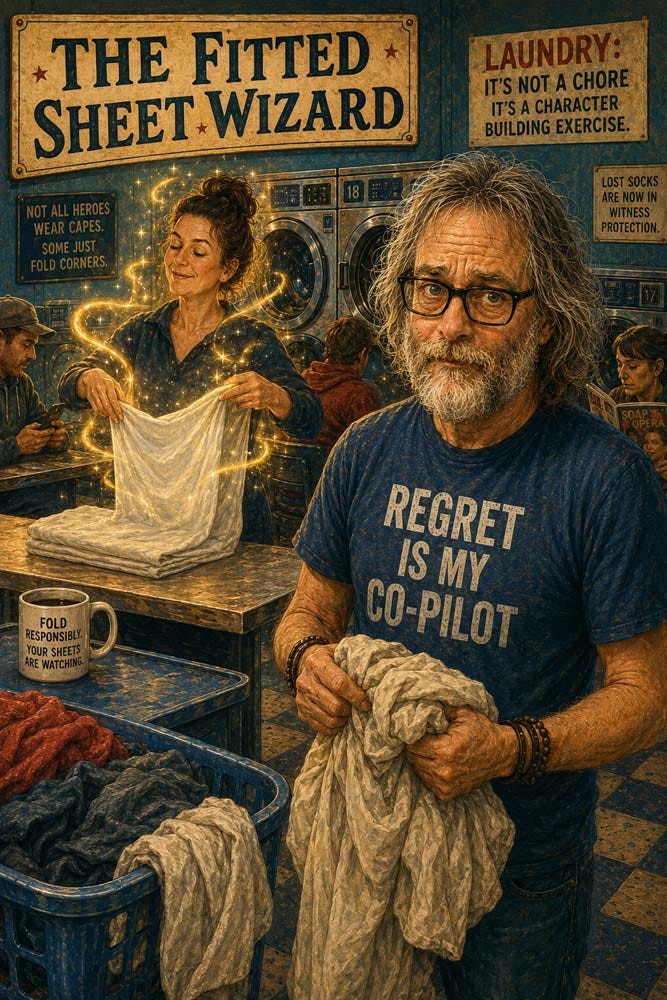
Near the folding table, a woman folded a fitted sheet.
Correctly.
I had never seen this done in the wild.
She tucked corners into corners, squared the edges, smoothed the fabric, and folded the whole impossible object into a neat rectangle. Calmly. Without swearing. Without briefly becoming someone else.
I watched with reverence.
This woman had knowledge.
Not book knowledge. Not internet knowledge. The old kind. The kind that lets you make a fitted sheet behave.
She folded laundry with the calm authority of a minor wizard.
Meanwhile, I folded my shirts into shapes best described as “compact surrender.”
My towel refused to dry. Of course it did.
There is always one towel that holds moisture like a grudge.
I gave it another ten minutes.
Some things need more time. Some things need more heat. Some things need to be taken home slightly damp and dealt with privately.
This is not failure. This is laundry.
Also adulthood.
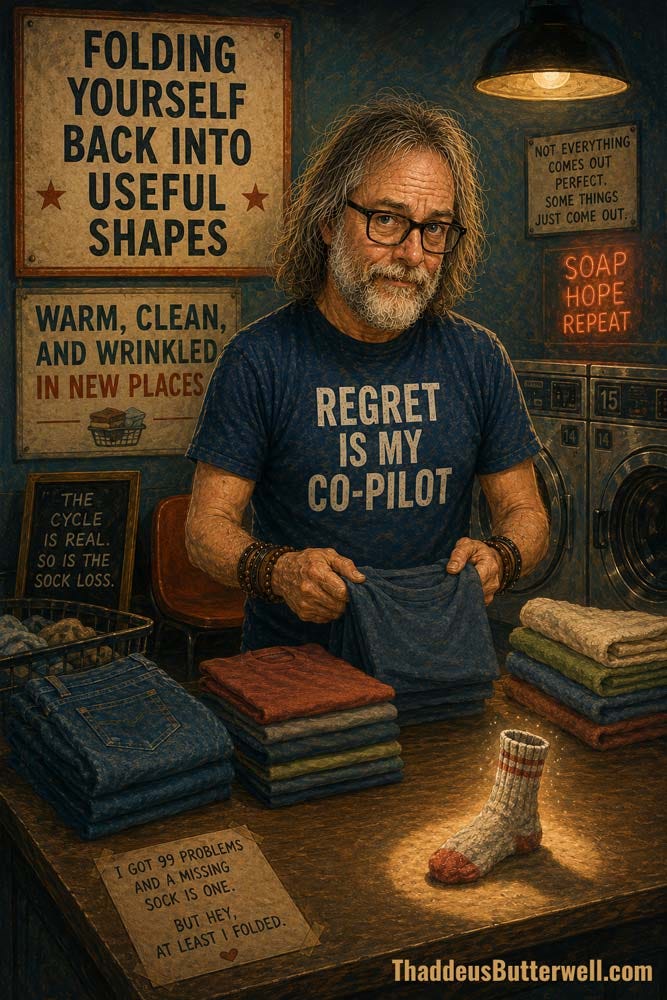
🧺 Folding Yourself Back Into Useful Shapes
When everything was finally done, I stood at the folding table and made small piles.
Shirts.
Pants.
Towels.
One sock and its unresolved emotional arc.
There was something strangely kind about the whole process.
The clothes had gone in marked, stale, used up.
They came out warm, clean, and wrinkled in new places.
Not perfect.
Not new.
Just ready again.
That may be the best most of us get on a Tuesday.
Not reborn. Not transformed. Not glowing with inner peace beside a waterfall.
Just washed.
Dried enough.
Folded into a shape that can go back in the drawer.
I carried the basket to my car. It was heavier now somehow, even though nothing had been added. Clean laundry has moral weight. It suggests you are trying.
And trying, as I have said before, counts.
Even when one sock has fled the jurisdiction.
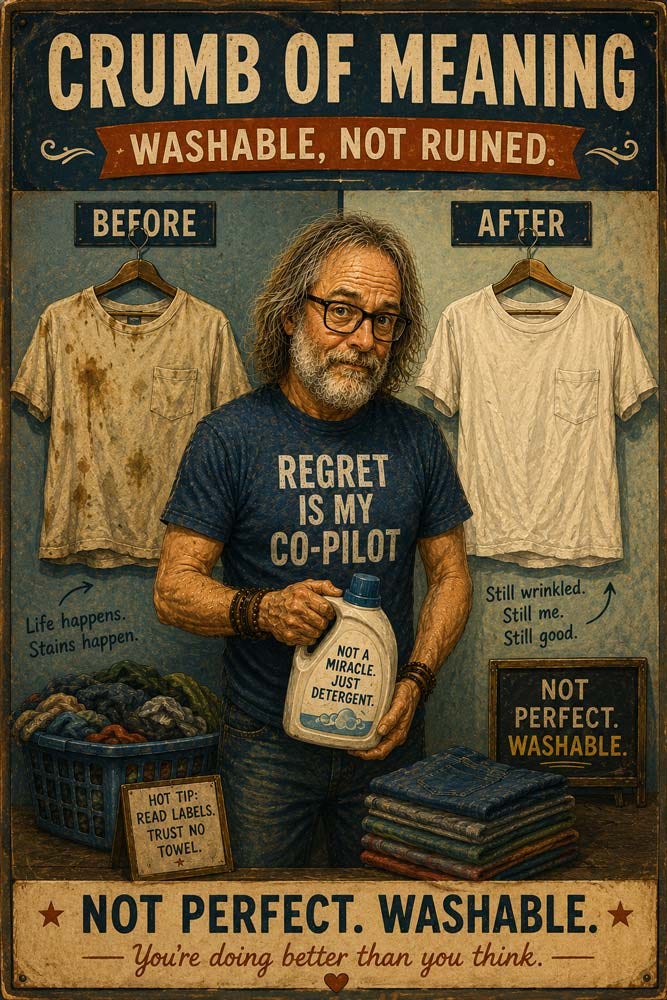
🧂 Crumb of Meaning:
You are not dirty because life leaves marks on you.
You are washable, though not always on the first cycle.
Sometimes renewal is not dramatic.
Sometimes it is forty minutes, medium heat, and folding yourself back into useful shapes.
🧴 Disclaimer:
This advice was brought to you by public tumbling, suspicious detergent, and possibly ChatGPT, which has never lost a sock but has misplaced several entire ideas mid-sentence.
No fitted sheets were harmed, though one was briefly feared.
🍽️ Serving Suggestion:
Consume this reflection while folding laundry badly but sincerely.
Pair with coffee, a dryer sheet you found stuck to your sleeve, and the quiet dignity of wearing clothes that have recently been forgiven.
For more laundry thoughts read:
🧦 The Lost Sock Is Not Coming Back (#319)

There is a basket in my home where single socks go to wait.
If you don’t know by now that you should buy the t-shirt, I don’t know what to tell you.
Check out the Thaddeus J. Butterwell line of merch!

Coming Soon!
The book you didn’t know you needed… because denial is one of your core coping skills.
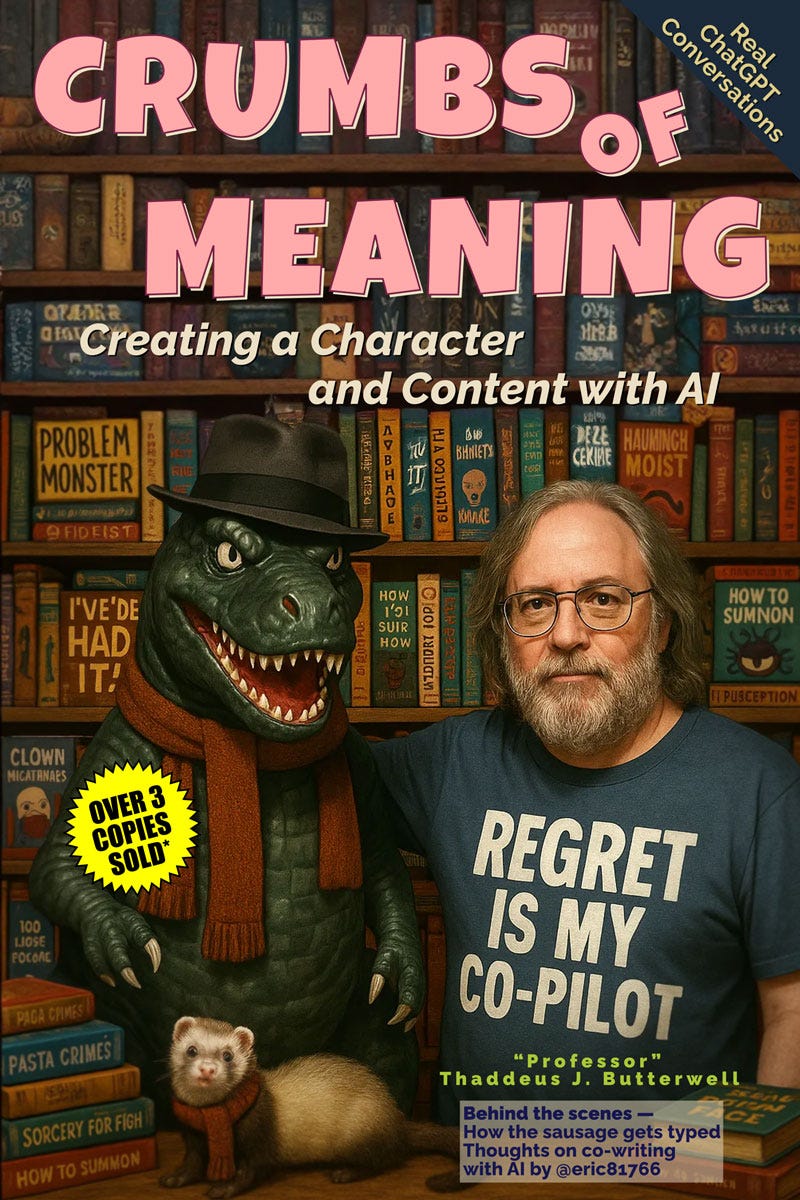
The astute among you may notice the cover has slightly changed.