🧦 The Lost Sock Is Not Coming Back (#319)
On laundry grief, cotton ghosts, and finally releasing the tiny tube of denial.

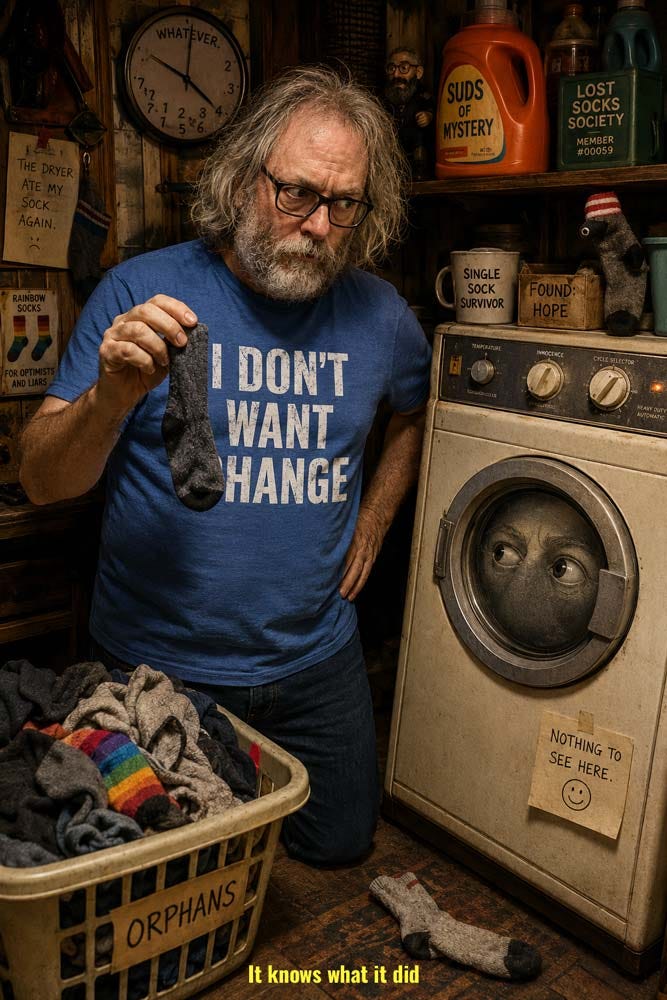
There is a basket in my home where single socks go to wait.
I do not call it a basket of lost causes.
That would be cruel.
I call it the Pending Department.
The Pending Department sits near the laundry area with the quiet optimism of a small-town bus station. Inside are socks of every color, thickness, and emotional condition. Dress socks. Athletic socks. Winter socks. One sock with tiny sandwiches on it that I am almost certain once had a partner, though perhaps I invented the partner as a coping mechanism.
Every few weeks, I reach into the basket and conduct what I refer to as “the reunion process.”
This involves holding up one sock, looking around for its mate, sighing, and putting it back.
It is not efficient.
But neither is hope.
And so, on National Lost Sock Memorial Day, we gather—emotionally, if not hygienically—to honor the missing.
Not the socks we threw away because they had holes. Not the socks we downgraded to dust rags after they became more ankle rumor than garment.
No.
Today we remember the vanished.
The ones who entered the washing machine as part of a pair and never emerged with their marriage intact.
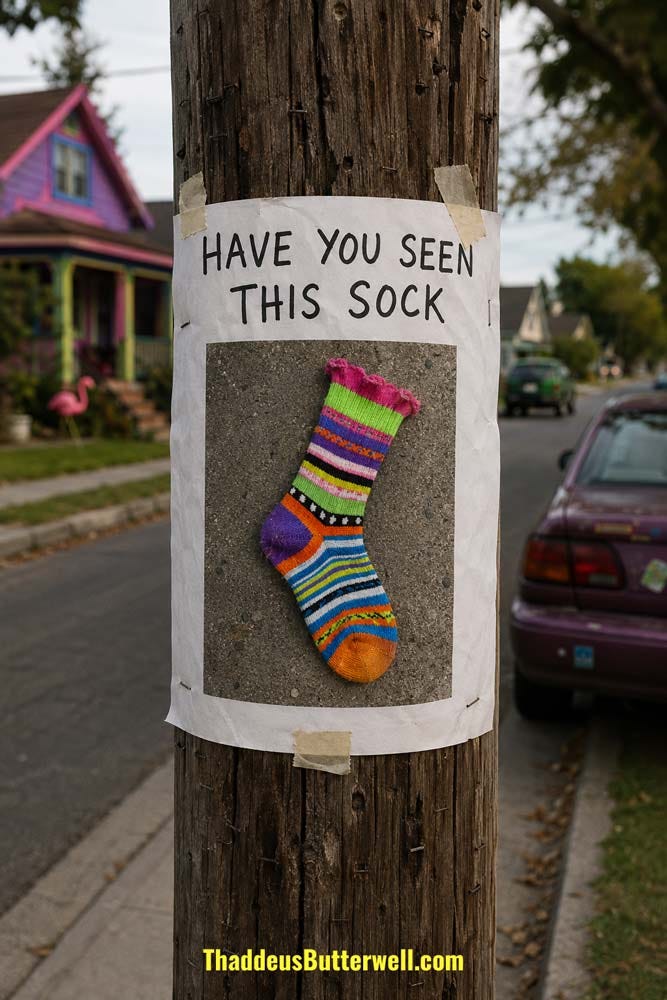
🕳️ Where Do They Go?
Science has theories.
I have chosen to ignore most of them.
Apparently socks can get trapped in dryer vents, wedged in machinery, hidden inside sheets, or swallowed into the general chaos of domestic life. Fine. Very responsible. Very clipboard.
But none of that explains the emotional mystery.
Because a missing sock does not feel like a mechanical event. It feels like a betrayal performed by cotton.
You put two socks in.
You get one sock out.
That is not laundry.
That is a magic trick conducted by an appliance with unresolved issues.
I have long suspected the dryer is not a machine at all, but a portal. Somewhere beyond the lint trap, there is a soft, dimly lit realm where single socks live freely in little cabins, drinking tea from thimbles and refusing to discuss their former lives.
Some are happy there.
Some have remarried.
Some run bookstores.
One of mine—navy blue, ribbed, left foot, slightly judgmental—probably became mayor.
I wish him well, though I remain hurt by the way he left.
🧺 The Orphan Sock Collection
Everyone has a place for unmatched socks.
A drawer.
A bag.
A corner of the laundry basket.
A cardboard box marked “miscellaneous,” which is one of the saddest words in the English language because it means, “I have given up but alphabetically.”
At first, keeping the single socks feels practical. The mate may return. It could be stuck inside a pillowcase. It may be hiding in a pant leg. It may appear next Tuesday under the bed, dusty but alive, like a soldier returning from a sock-based war.
So you wait.
Then a month passes.
Then six.
Then you realize you have been preserving a dead relationship in elastic form.
This is when the orphan sock pile becomes less about laundry and more about identity.
Who are we, really?
Are we people who let go?
Or are we people who keep one argyle sock for fourteen months because “you never know”?
I have been both.
Mostly the second.
There was one gray sock I kept through three apartments, two tax seasons, and a deeply regrettable attempt to learn the mandolin. I could not throw it away. It had been good to me. It had supported my arch through difficult errands.
But its partner was gone.
Eventually, I had to admit that I was not storing a sock.
I was storing a theory of reunion.

✨ Repurposing Is Not Betrayal
Some people say you should throw the orphan socks away.
I find this harsh.
Not wrong, necessarily. Just harsh in the way dentists are harsh when they say, “How often are you flossing?” and you reply with your eyes.
A single sock may no longer be a sock in the traditional paired-foot sense, but that does not mean its usefulness has ended.
It can become a dust rag.
A dog toy.
A sock puppet with emotional range.
A protective sleeve for something fragile.
A small mitten for a jar you have decided is cold.
This is not failure.
This is vocational retraining.
The sock has not lost its purpose. It has merely been reassigned by the Department of Unexpected Fabric.
I admire this.
I would like to believe the same is true for people.
Sometimes the thing you thought you were paired with disappears. A job. A routine. A version of yourself. A plan that once fit snugly and then vanished somewhere between the rinse cycle and adulthood.
At first, you sit in the basket waiting.
You believe the old life will come back and match you.
Maybe it does.
Often it does not.
Then the question becomes: are you trash, or are you becoming something else?
I vote something else.
Possibly a puppet.
Possibly a dust rag.
There is dignity in both, depending on lighting.
🧦 The Memorial Service
I believe Lost Sock Memorial Day should be observed properly.
Not extravagantly. We are not renting a hall.
But perhaps you stand before your orphan sock collection and say a few words.
“Thank you, blue striped sock, for your service during the winter of 2022.”
“Thank you, black dress sock, for helping me appear employable at that wedding.”
“Thank you, novelty taco sock, for making one ankle whimsical while the other remained professionally neutral.”
Then you decide.
Some socks are released.
Some are repurposed.
Some are kept because you are not emotionally ready, and that is allowed, provided you admit what is happening.
Denial is when you say, “I’m sure the other one will turn up.”
Honesty is when you say, “I know the other one is gone, but I am not prepared to bury this ankle tube today.”
That distinction matters.
A person can live with a little mess if they know what it is.
The danger is not the orphan sock pile.
The danger is pretending it is still a system.
🧭 A Sock Sorting Board and Other Dreams of Control
Google tells me some people use sock sorting boards to keep pairs together.
This sounds sensible.
It also sounds like the kind of object owned by people whose junk drawers have subcommittees.
I respect them.
I am suspicious of them.
A sock sorting board is an attempt to bring order to a universe that clearly enjoys minor fabric crimes. It says, “Not today, chaos.” It clips the pairs together. It labels. It prevents cotton abandonment.
Very good.
But even the best systems cannot stop every disappearance. Eventually, something slips away. A sock, a receipt, a plan, a Saturday afternoon.
Life is mostly trying to keep pairs together while the dryer hums ominously in the background.
You do what you can.
You match what matches.
You fold what folds.
You stop demanding that every lost thing explain itself.
🧂 Crumb of Meaning:
Not everything that loses its pair has lost its purpose.
Some things come back.
Some things become rags.
Some things become puppets.
And some things sit in the basket a little longer because the heart is also a laundry room, and not every load is ready to be folded.
🤖 Disclaimer:
This advice was generated with artificial intelligence, human laundry trauma, and several unmatched socks whose legal status remains unresolved.
No dryer was directly accused.
But it knows what it did.
🍽️ Serving Suggestion:
Consume with coffee, one basket of suspicious fabric, and the courage to throw away at least one sock you have been calling “pending” since the previous presidential administration.
Optional: make a puppet first.
Closure is easier with googly eyes.
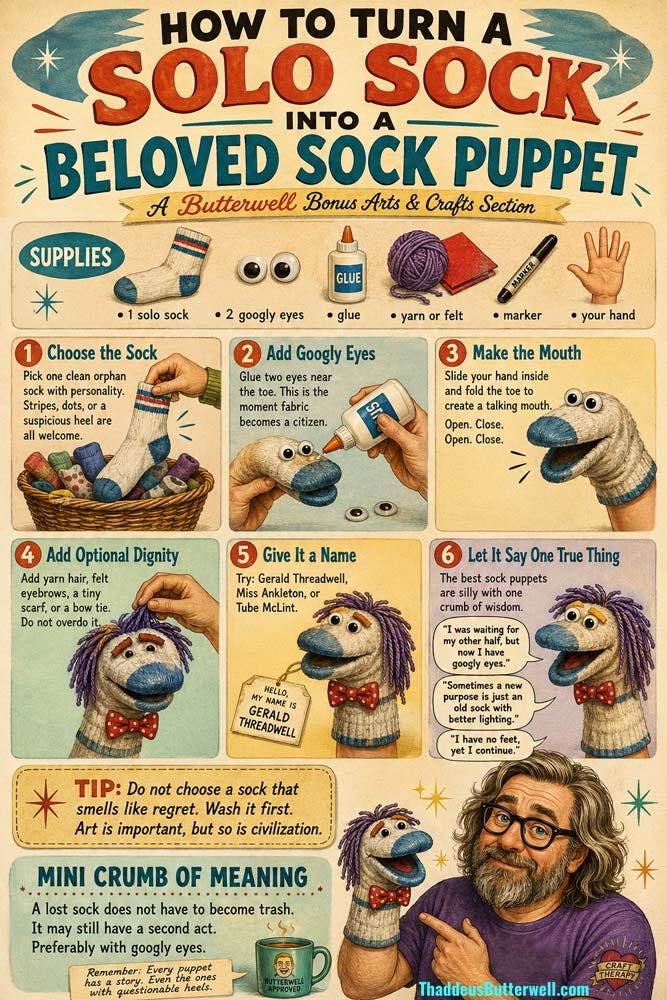
🧶 Bonus Arts & Crafts: How to Turn a Solo Sock Into a Beloved Sock Puppet
Because not every lost partnership has to end in the trash.
A single sock is not useless.
It is simply between assignments.
Once, it was part of a pair. It had a mate, a purpose, and a foot-based domestic arrangement. Now it sits alone in the basket, wondering whether love was ever real or if the dryer was always lying.
This is where we intervene.
Not with pity.
With googly eyes.
🧦 Step 1: Choose the Sock
Select one orphan sock with personality.
A good puppet sock should have some emotional mileage. A stripe. A weird pattern. A suspicious heel. Something that suggests it has stories and possibly opinions about soup.
Do not choose a sock that smells like regret. Wash it first. Art is important, but so is civilization.
👀 Step 2: Add Eyes
Attach two googly eyes near the toe.
This is the sacred moment when fabric becomes witness.
Before the eyes, it is a sock.
After the eyes, it is a small textile citizen with concerns.
You may use glue, needle and thread, or whatever adhesive has not yet betrayed you in the junk drawer. Place the eyes carefully. Too close together and the puppet looks worried. Too far apart and it appears to have seen the future and found it poorly folded.
Either is acceptable.
🧶 Step 3: Give It a Mouth
Slide your hand inside the sock and fold the toe inward slightly to create a mouth.
Open.
Close.
Open.
Close.
There it is.
Speech.
Possibly judgment.
At this stage, your sock puppet may begin developing a tone. Some sound cheerful. Some sound sarcastic. Some sound like they have been waiting three years to discuss the laundry system.
Let the puppet tell you who it is.
This is not madness.
This is character development.
🎩 Step 4: Add Optional Dignity
You may decorate your puppet with yarn hair, felt eyebrows, a tiny scarf, a paper bow tie, or a mustache drawn with a marker you should absolutely test first.
Do not overdo it.
A sock puppet needs only enough detail to become specific. Too much decoration and suddenly you are not making a puppet; you are launching a regional theater company from inside a sock.
Unless that is your goal.
In which case, congratulations. You are unwell in an organized way.
🎭 Step 5: Introduce the Puppet Properly
Do not simply say, “Here is a sock puppet.”
That is rude.
Give it a name.
Ask it how it feels.
Let it complain about being single, damp, and repurposed without proper paperwork.
Possible names include:
Gerald Threadwell.
Miss Ankleton.
Sir Lefty of the Hamper.
Brenda.
The Honorable Tube McLint.
Once named, the puppet has dignity.
Not legal dignity.
But enough for a kitchen performance.
🍪 Step 6: Let It Say One True Thing
The best sock puppets are not merely silly. They are silly with one tiny crumb of truth stuck to them.
Let your puppet say something honest, such as:
“I was waiting for my other half, but now I have googly eyes.”
Or:
“Sometimes a new purpose is just an old sock with better lighting.”
Or:
“I have no feet, yet I continue.”
That last one may be too powerful.
Use responsibly.
🧂 Mini Crumb of Meaning:
A lost sock does not have to become trash.
It can become a puppet.
It can become a voice.
It can become the weird little proof that even after the dryer ruins your plans, you may still have a second act.
Preferably with googly eyes.
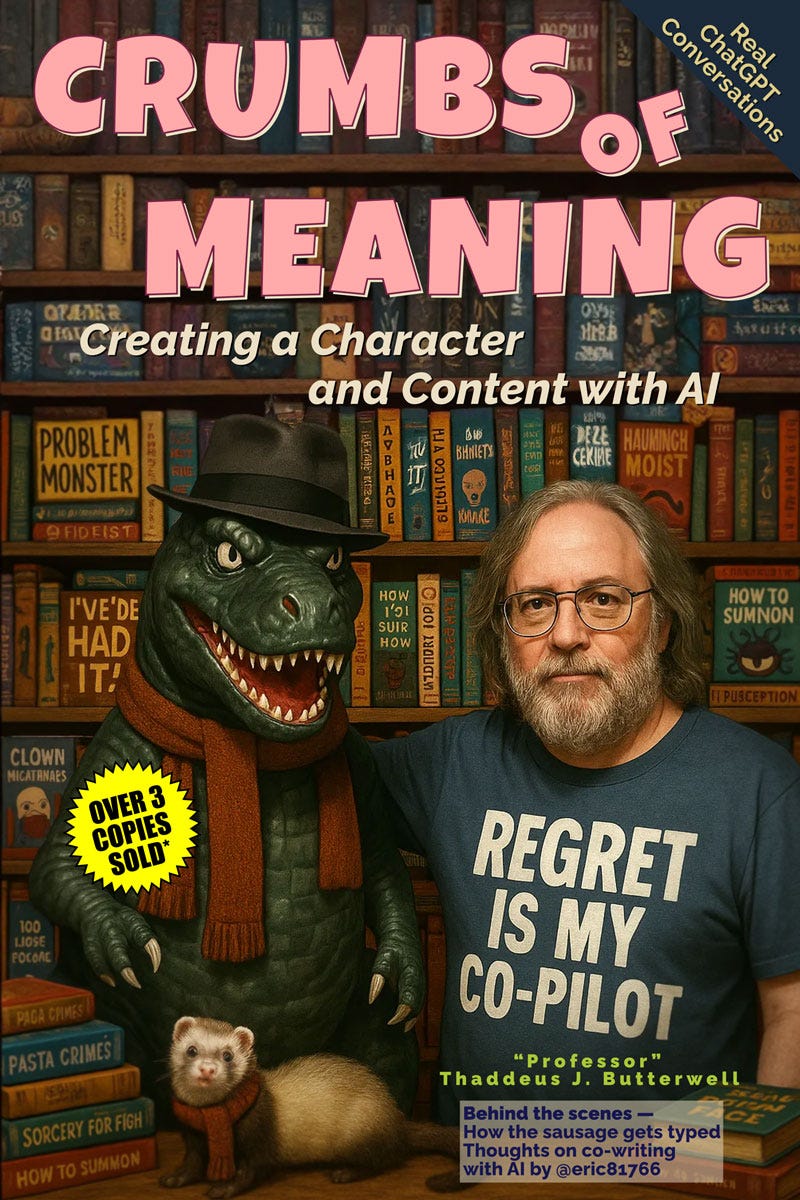
If you don’t know by now that you should buy the t-shirt, I don’t know what to tell you.
Check out the Thaddeus J. Butterwell line of merch!

Coming Soon!
The book you didn’t know you needed… because denial is one of your core coping skills.
The astute among you may notice the cover has slightly changed.
BEHIND THE SCENES