🛏️ The Pea Was Not the Main Problem (#358)
The pea had excellent public relations.

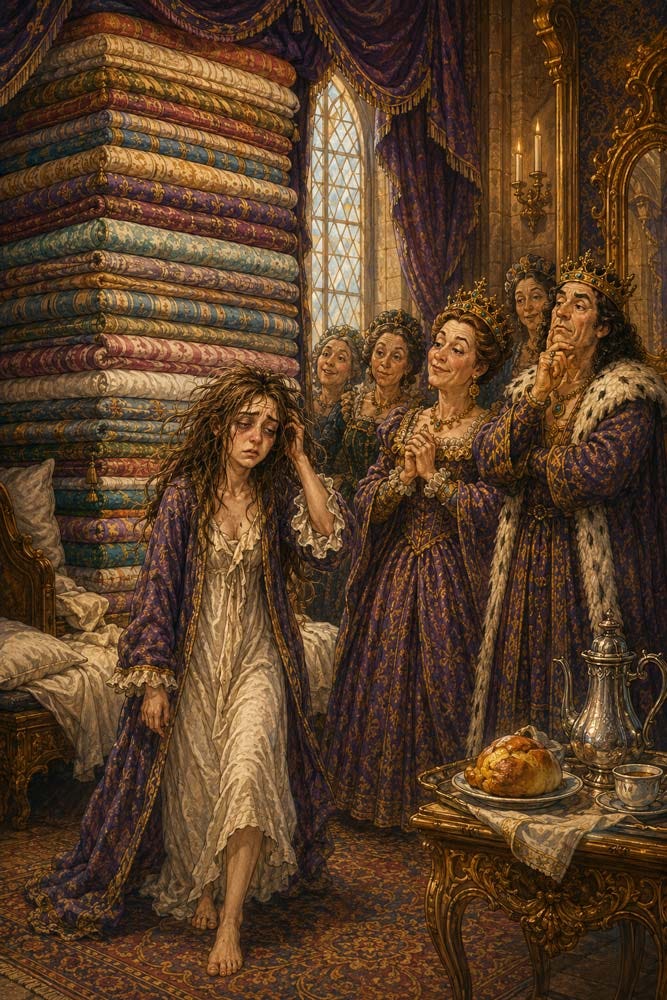
The princess had not slept.
This was considered proof of royalty.
I considered it proof that someone had built a bed with the structural logic of a layer cake.
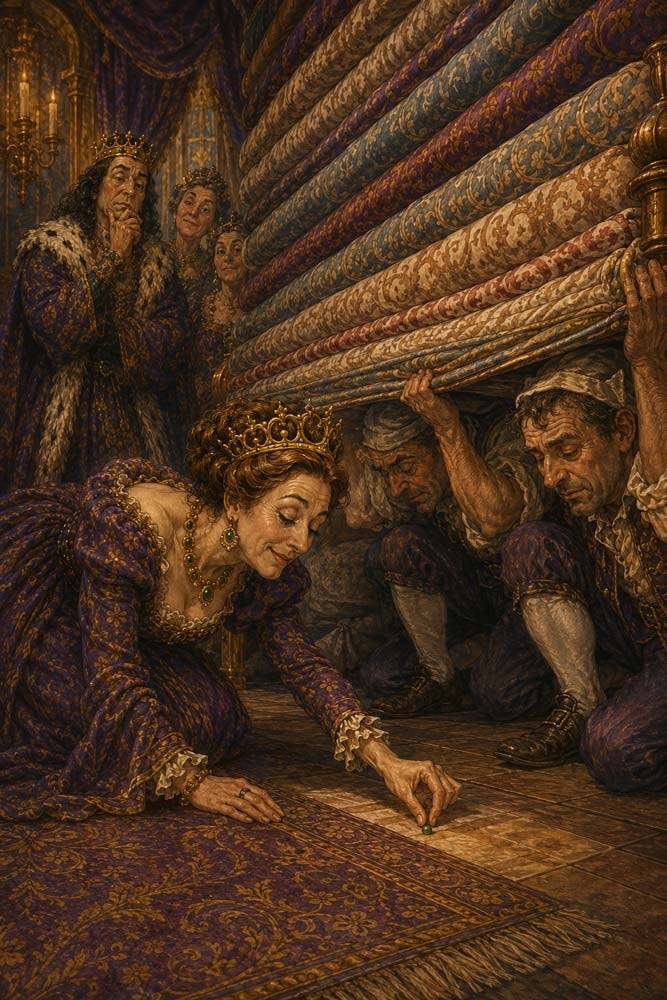
Twenty mattresses had been stacked on top of one another in the royal guest chamber. Beneath the bottom mattress, the queen had placed a single pea.
The theory was simple.
A true princess would be so sensitive that she could feel the pea through all twenty mattresses.
By morning, the princess emerged pale, exhausted, and barely able to finish a buttered roll.
The court applauded.
The king declared the test a success.
The queen announced that they had finally found a suitable bride for the prince.
I looked at the tower of mattresses swaying slightly behind them.
“Has anyone considered,” I asked, “that the bed itself may be the problem?”
No one had.
This is common in royal investigations.
The conclusion arrives first.
The furniture is questioned later.
👑 Royal Sleep Theater
The queen showed me the guest chamber.
The mattresses were stacked so high that the princess had required a small ladder to reach the top.
The ladder had been removed during the night.
This was apparently part of the test.
“Did she complain about the pea?” I asked.
“She said she was uncomfortable,” said the queen.
“That could describe sleeping twenty feet above the floor on a wobbling tower of upholstery.”
The queen frowned.
“She felt something beneath her.”
“At that height, she may have felt weather.”
I climbed the ladder and pressed down on the top mattress.
The entire bed shifted.
A decorative pillow slid off and struck a footman.
No one reacted.
The palace had normalized several things.
I asked whether the mattresses had been tied together.
They had not.
I asked whether the frame had been reinforced.
It had not.
I asked whether anyone had checked the room for drafts, squeaking windows, bells, guards, peacocks, or courtiers standing outside the door whispering about whether the princess was asleep.
The queen looked uncomfortable.
“How many times did you check on her?” I asked.
“Only twelve.”
There it was.
The pea had excellent public relations.
📱 The Pea Challenge
Unfortunately, news of the princess’s sleepless night spread.
By noon, the story had reached the village.
By evening, it had become a trend.
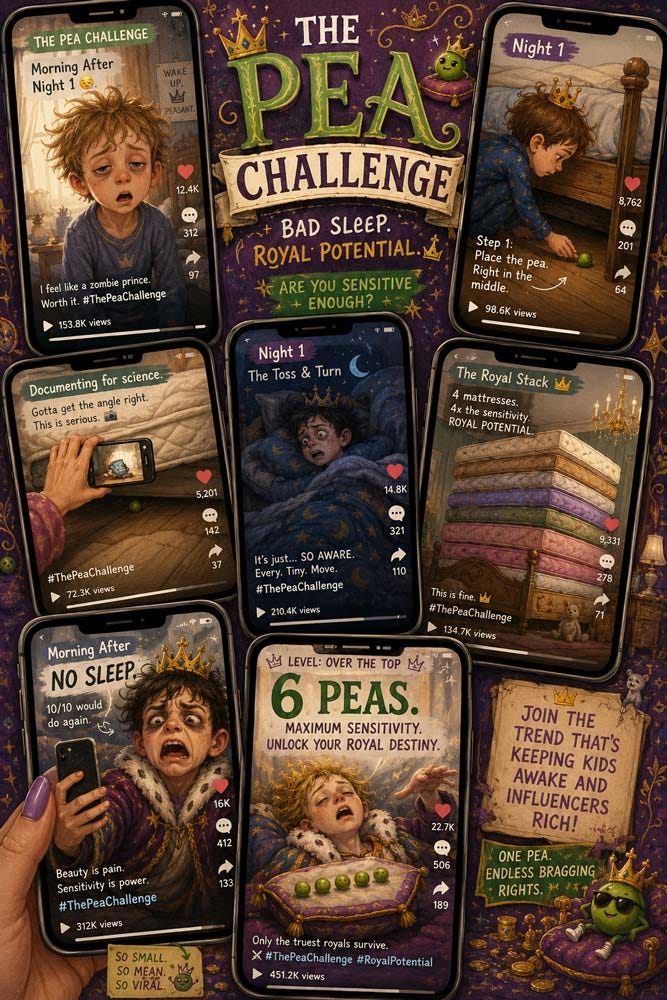
Young people began placing peas beneath their mattresses and posting dramatic accounts of their suffering.
The Pea Challenge became a test of sensitivity, refinement, and royal potential.
One boy used six peas because he wanted to appear emotionally advanced.
A girl stacked four mattresses in her bedroom and had to be removed through a window.
Several children refused to sleep until their parents had photographed the pea going under the bed.
The next morning, half the students in the kingdom fell asleep at school.
One child nodded off during arithmetic and woke believing seven was a vegetable.
Teachers complained.
Parents blamed the schools.
The schools blamed the peas.
Pea sales rose sharply.
This is how social problems develop.
First, someone has a bad night.
Then everyone needs evidence that they are having one too.
The royal court tried to distance itself from the trend.
This was difficult because the queen had already released commemorative pea-shaped pillows.
🧺 The Floor Experiment
I decided to test the royal method myself.
For scientific balance, I slept one night on the twenty mattresses.
I lasted eleven minutes.
The stack creaked.
The room swayed.
Every time I moved, the top mattress traveled slightly in a direction not approved by the lower mattresses.
I became aware of gravity in a personal way.
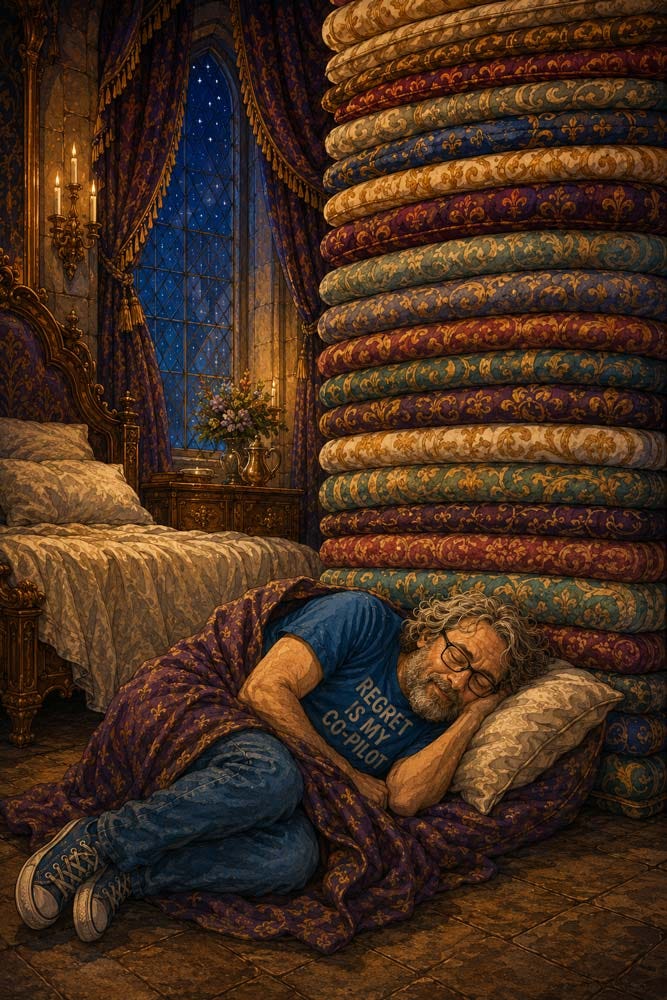
At midnight, I climbed down and slept on the floor.
The stone was hard.
It was cold.
It offered no luxury whatsoever.
I retrieved a pillow and blanket that had fallen from the mattress stack, made a small nest on the floor, and slept for seven uninterrupted hours with better lumbar support than the royal bed.
The court was not pleased.
“You slept on the floor?” asked the king.
“I conducted a control.”
“You are not royal.”
“My spine did not ask.”
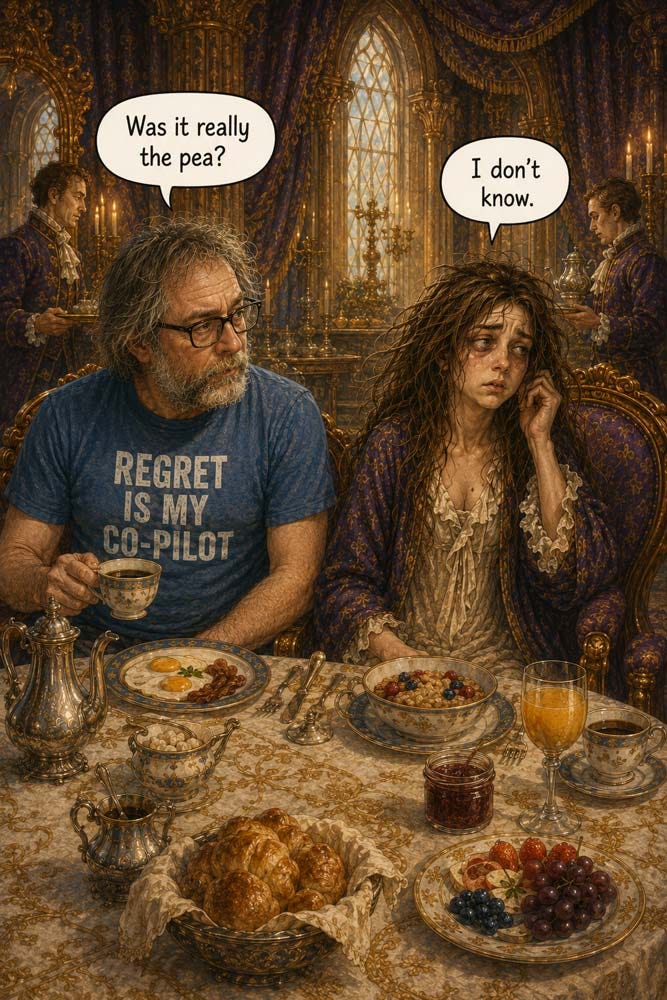
The princess found me at breakfast.
She looked tired again.
“Was it really the pea?” I asked.
She glanced around to make sure the queen was not listening.
“I don’t know.”
“What kept you awake?”
“The bed moved.”
“Yes.”
“The curtains rattled.”
“Yes.”
“Someone opened the door every twenty minutes.”
“Yes.”
“And the queen kept whispering, ‘Can you feel it?’”
I put down my toast.
“The pea was not the main problem.”
“No,” said the princess. “But it was the smallest one, so everyone preferred it.”
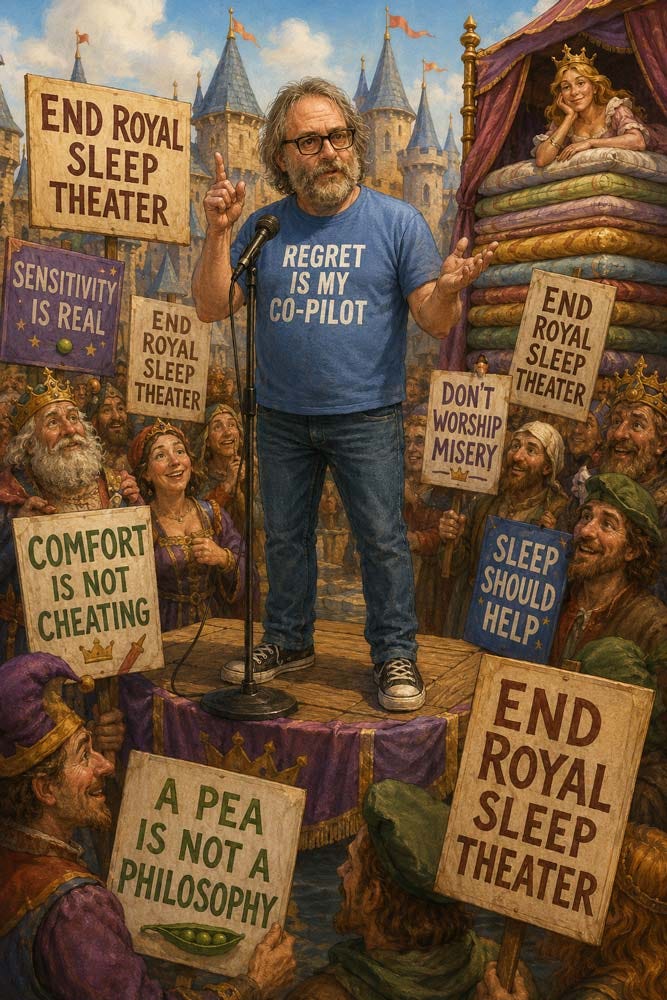
📣 End Royal Sleep Theater
Within a week, I launched a public campaign called:
END ROYAL SLEEP THEATER
Our message was simple.
Sensitivity is real.
Discomfort is real.
But not every miserable environment becomes meaningful because someone hides a vegetable underneath it.
We removed nineteen mattresses from the guest chamber.
We secured the remaining one to an actual bed frame.
We fixed the window.
We banned overnight observation except in genuine emergencies.
The queen was permitted one check before bedtime and one in the morning.
She appealed.
The appeal was denied.
Across the kingdom, schools began teaching basic sleep habits.
Peas returned to soup.
Mattresses returned to beds.
Children stopped treating exhaustion as evidence of depth.
The princess slept through the night.
In the morning, the queen asked whether she had felt anything unusual.
“Yes,” said the princess.
The queen leaned forward.
“What?”
“Rested.”
This was not the answer she wanted.
It was, however, the answer she needed.
People often assume sensitivity means the person is the problem.
Too delicate.
Too reactive.
Too aware.
Sometimes that is true.
Sometimes the mattress tower is unstable, the window is rattling, twelve people are checking on you, and someone has turned your discomfort into a public test.
Sensitivity is not always weakness.
Sometimes it is accurate reporting from a nervous system trapped in a badly managed room.
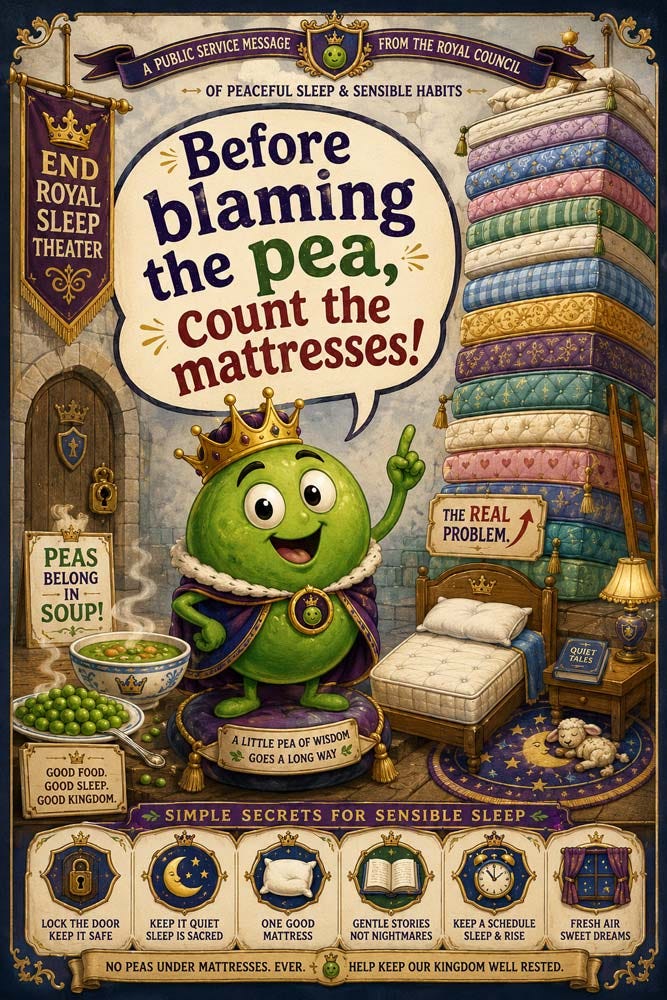
🛏️ Crumb of Meaning:
Sensitivity is real, but sometimes the environment is making it worse. Before blaming the pea, count the mattresses and ask who keeps opening the door.
🤖 Disclaimer:
This account was assembled from fairy-tale memory, sleep deprivation, social trends, and assistance from artificial intelligence. Peas should be eaten, planted, or ignored—not used to measure emotional worth.
🥣 Serving Suggestion:
Consume after a full night’s sleep with one sturdy mattress, a locked door, and peas safely contained in soup.
If you don’t know by now that you should buy the t-shirt, I don’t know what to tell you.
Check out the Thaddeus J. Butterwell line of merch!

Coming Soon!
The book you didn’t know you needed… because denial is one of your core coping skills.
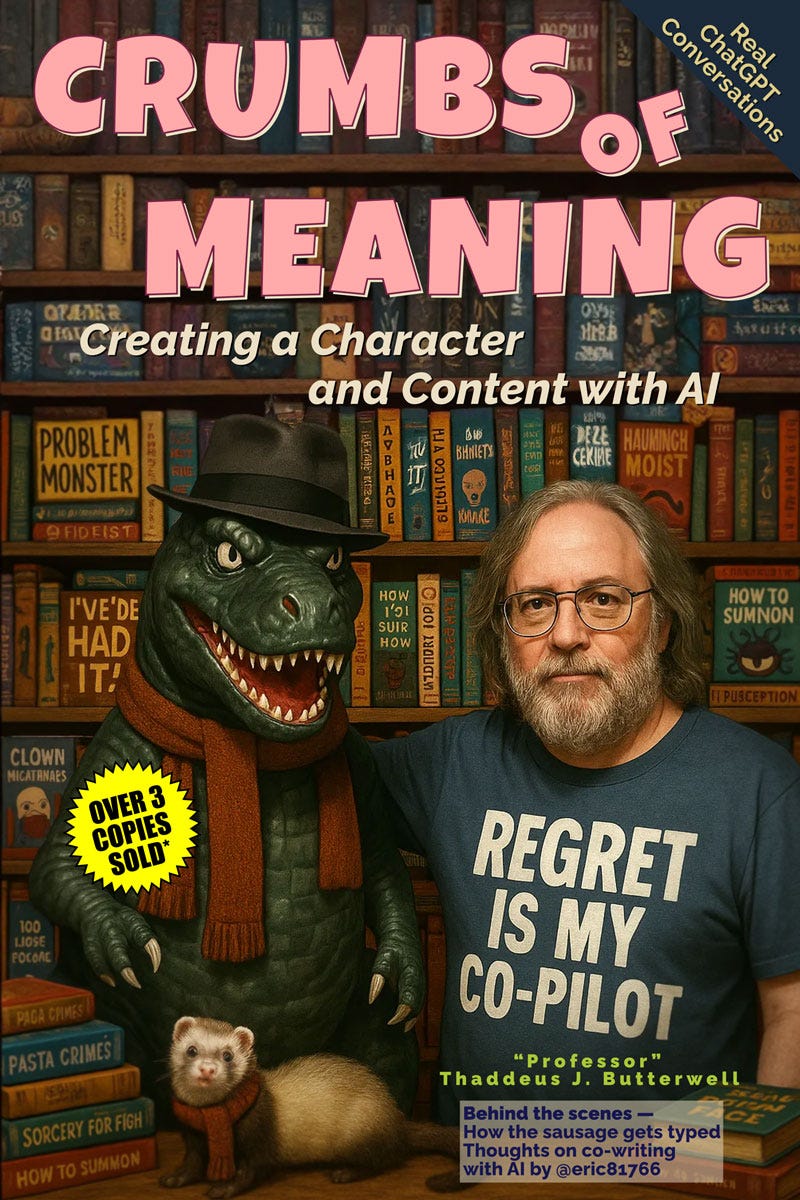
The astute among you may notice the cover has slightly changed.