🔐 My Password Is “PleaseDon’tRobMe123” (#317)
On Post-it notes, digital pantry doors, and the quiet dignity of basic security.

Let us begin with a confession.
For many years, my approach to online security was based on three principles:
Hope.
Denial.
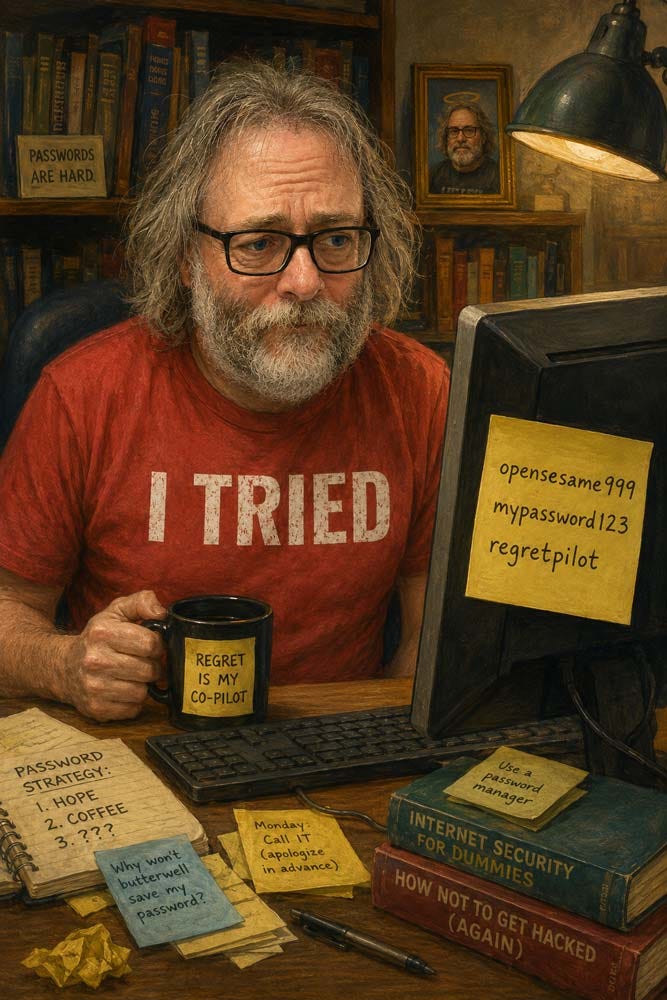
And one yellow Post-it note clinging to my monitor like a tiny flag of surrender.
The Post-it said things like:
opensesame999
regretpilot
mypassword123
And, for one deeply vulnerable period, the name of a childhood pet who absolutely did not ask to protect my bank account.
I knew this was bad.
Of course I knew.
I am not a complete fool. I am a partial fool with glasses and a mug that says something emotionally incriminating. I understood, in the abstract, that passwords should be strong, unique, and stored somewhere safer than “on the thing a burglar would look at first.”
But understanding a thing and doing a thing are cousins who do not always speak at Thanksgiving.
Passwords are annoying.
They are not glamorous. They do not smell like fresh bread or make you feel reborn. No one changes a password and then walks slowly through a sunlit meadow while a voiceover says, “At last, he became whole.”
Mostly, you sit there squinting at a screen while it says your new password needs another symbol, a capital letter, a number, a hieroglyph, and the emotional consent of a lighthouse.
Still.
It has to be done.
Like flossing.
Like changing the smoke detector battery.
Like finally throwing away the mystery container in the fridge that has become less “leftovers” and more “tenant.”
🧻 The Post-it Note Is Not a Security System
A Post-it note is many things.
It is a reminder.
A tiny paper billboard.
A place to write “CALL DENTIST” and then avoid eye contact with it for eight months.
But it is not a security system.
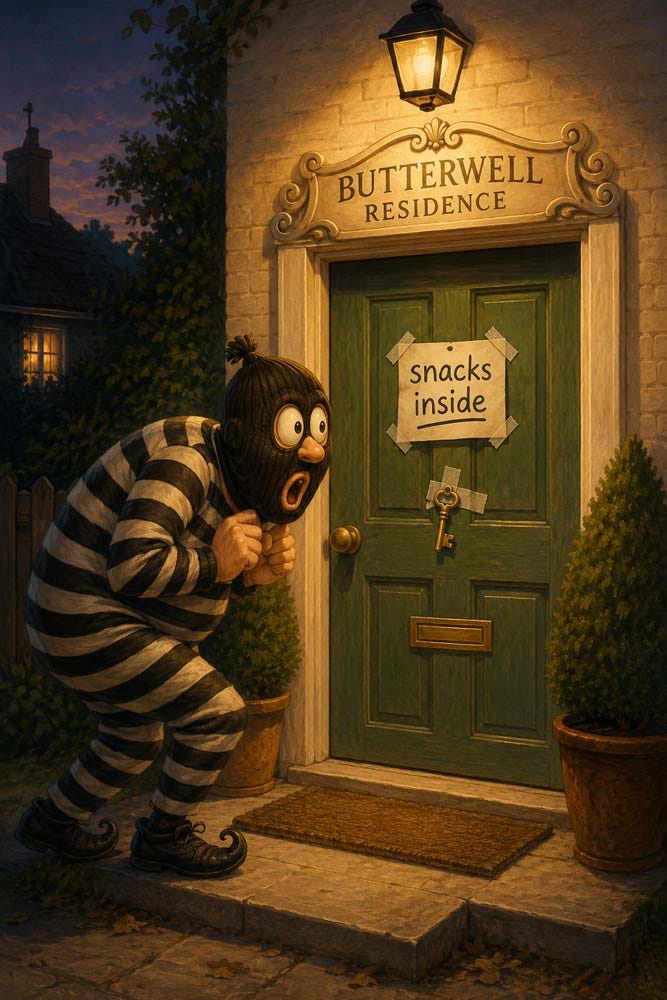
Writing your password on a note and sticking it to your monitor is less “data protection” and more “decorative confession.” It is the digital equivalent of taping your house key to the front door under a sign that says:
SNACKS INSIDE.
And yes, I understand the temptation. We are all tired. Every website wants an account. Every account wants a password. Every password wants to be “strong,” as if it has been deadlifting in a basement.
You make one password you can remember, and suddenly it feels like a household tool.
Why not use it everywhere?
It works.
It opens things.
It has served faithfully.
So has a butter knife, but I would not use one to perform dental surgery.
This is the point at which adulthood becomes irritatingly specific.
🥣 Do Not Use the Same Spoon for Every Soup
Using the same password everywhere feels efficient until something goes wrong.
It is like using one spoon for every soup in your life.
Tomato soup.
Lentil soup.
Clam chowder.
Emotional bisque.
Bank account stew.
At first, it seems practical. One spoon. One life. Fewer dishes. A clean philosophy for a person who already has enough drawer-based confusion.
Then one soup goes bad.
Suddenly everything tastes like regret.
That is what happens when one reused password gets exposed. One little leak, one breached account, one forgotten login from a website where you bought novelty socks in 2014, and now the same password may unlock your email, your shopping accounts, your streaming service, and possibly the sacred archive of things you Googled while tired.
A unique password for each account is not overkill.
It is basic kitchen separation.
You do not store raw chicken in the cookie tin. You do not stir gravy with the bathroom toothbrush. You do not let one hacked casserole contaminate the whole buffet.
This is not paranoia.
This is not tech bro survivalist nonsense with a bunker and a ring light.
This is simply not putting all your soup in one spoon.
🧅 The Password Should Not Know Your Childhood Dog
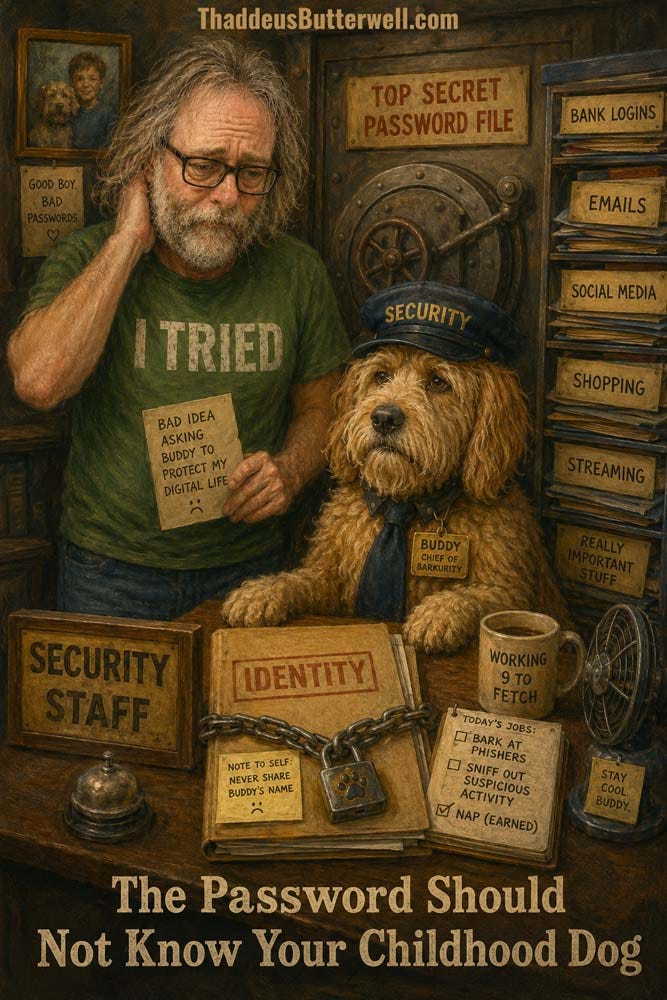
I loved my childhood dog.
He was loyal, expressive, and once ate half a paperback copy of The Hobbit, which made him either illiterate or very committed to fantasy.
But he should not be guarding my identity.
Neither should your birthday, your street name, your favorite team, your favorite sandwich, or the word “password” with an exclamation point taped to the end like a fake mustache.
Cybercriminals are not sitting in dark rooms guessing your secrets by candlelight while wearing opera capes. They use tools. They use lists. They use stolen password databases and software that can try more combinations than a panicked person choosing what to eat after 9 p.m.
Meanwhile, many of us are out here protecting our entire digital existence with something like:
Fluffy1987!
I say this with compassion.
Fluffy did enough.
Let the dog rest.
🔐 Maintenance Is Still Care
Here is the part I resist.
Password maintenance does not feel like self-care.
It does not have the soft glow of a bath, the moral cleanliness of a walk, or the immediate emotional payout of eating toast over the sink while muttering, “This counts.”
It feels like admin.
And admin is where the soul goes to wait under fluorescent lights.
But annoying maintenance is still care.
A strong password is not a transformation. It is not a lifestyle. It will not fix your sleep schedule or explain why your printer hates you.
It is a rubber band of digital adulthood.
Small. Useful. Slightly boring. Easy to ignore until the bag opens and everything spills.
This is where small victories matter. You do not need to overhaul your entire digital life in one heroic evening while drinking cold coffee and swearing at a login page. That way lies madness, and possibly a new password called IhateThisWebsite42.
Start with one account.
Your email is a good candidate, because email is often the master pantry. If someone gets into it, they can reset the locks on half your life while you are downstairs wondering if cereal is dinner.
Then do another account later.
Then another.
This is not dramatic. It will not become a movie unless the movie is very slow and mostly about sighing.
But your future self may thank you.
Quietly.
Probably while looking for the scissors.
🗝️ You Are Human. Use Shelves.
The problem is not that you cannot remember 84 strong, unique passwords.
Of course you cannot.
That is not weakness. That is being a mammal with errands.
Your brain is already storing childhood embarrassment, three unpaid mental tabs, the theme song to a cartoon you have not seen since 1989, and the exact tone someone used when they said “interesting” in 2006.
There is not enough room in there for perfect password architecture.
So use a password manager.
I am not going to turn this into a tech article. I will not explain encryption while pointing at a chalkboard. No one wants Butterwell in front of a chalkboard unless there is a sandwich diagram involved.
But the idea is simple enough:
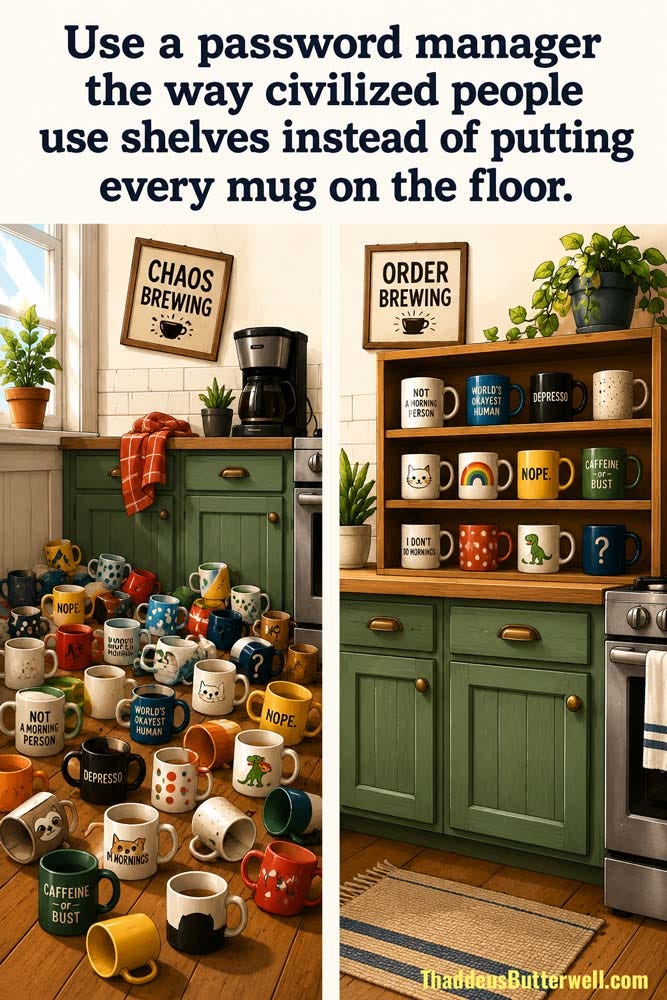
Use a password manager the way civilized people use shelves instead of putting every mug on the floor.
You still own the mugs.
You simply stop living like a raccoon curated your kitchen.
That is the whole spiritual lesson.
Organization is not betrayal.
Tools are not weakness.
The best tool is often the one that keeps you from trusting a Post-it note named Steve.
🧂 Crumb of Meaning:
You are not weak because you cannot remember 84 strong, unique passwords.
You are human.
Use a password manager the way civilized people use shelves instead of putting every mug on the floor.
A good system is not a failure of character. It is what keeps your digital kitchen from becoming a raccoon crime scene.
Stop taping the key to the door.
Stop trusting the Post-it note.
Give the mugs a shelf, give the passwords a manager, and let your brain go back to storing important things, like where you left the crackers.
🤖 Disclaimer:
This advice was assembled with lived anxiety, artificial assistance, and the haunted knowledge that somewhere, someone is still using password1 and calling it “good enough.”
It is not good enough.
It is a welcome mat with a login screen.
🍪 Serving Suggestion:
Consume with coffee, a quiet sense of dread, and one small password improvement made before the dread evaporates.
Pair with crackers.
Crackers understand vulnerability.
If you don’t know by now that you should buy the t-shirt, I don’t know what to tell you.
Check out the Thaddeus J. Butterwell line of merch!

Coming Soon!
The book you didn’t know you needed… because denial is one of your core coping skills.
The astute among you may notice the cover has slightly changed.