🪑 Butterwell Goes to a Furniture Store and Sits in Too Many Futures (#344)
Do not test-drive a recliner unless you are prepared to meet the man you might become.


I went to the furniture store for one sensible chair.
That was my mistake.
Never enter a furniture store with a modest goal. The building can sense weakness. It sees you approaching with your little practical intention and immediately surrounds you with lamps, ottomans, and twelve different versions of yourself who apparently entertain guests using cloth napkins.
I wanted a chair.
One chair.
A chair that said, “Here sits a man of reasonable lumbar expectations.”
Instead, I found myself wandering through a warehouse of imaginary stability, trying on futures like jackets I had no business owning.

🛋️ The Recliner Section Is a Personality Test With Cup Holders
The first recliner I sat in was brown leather and deeply confident.
It did not feel like furniture.
It felt like an oath.
The moment I lowered myself into it, I became a man who says things like, “I’ll look at the numbers,” while knowing absolutely nothing about the numbers.
This chair had opinions about property taxes.
It wanted me to own coasters.
It wanted me to have a favorite local hardware store employee named Glen.
I got up quickly.
The next recliner was plush, gray, and dangerously forgiving. It had a lever on the side and seemed designed for a man who had already changed into house pants and stopped answering texts.
I sat down and immediately understood weekend nap crime.
This was not a chair.
This was an accomplice.
It whispered, “You deserve rest,” which is how most avoidance naps begin.
Then there was the power recliner.
Buttons.
USB ports.
A headrest that rose up like it had been waiting years to correct me.
I pressed one button and tilted backward into regional management of my own decline.
For a moment, I saw the future: me, slightly reclined, remote in hand, silently judging television chefs for under-seasoning soup while wearing socks I did not remember buying.
I got up again.
But slowly.
Because the chair had made some excellent points.

🍋 Showroom Rooms Are Lies With Decorative Lemons
Furniture stores do not sell furniture.
They sell alternate timelines.
Every showroom quietly suggests you could become a better person if you owned a console table and stopped leaving batteries in bowls.
There was a fake living room with a cream sofa, two accent chairs, a tasteful rug, and a coffee table holding three books no human has ever opened.
There was a bowl of decorative lemons.
I became immediately suspicious.
No real home has that many lemons behaving politely in a bowl.
Real lemons have jobs. They go into tea. They become zest. They roll into the back of the refrigerator and come out later squishy, ashamed, and no longer welcome near beverages.
But these lemons had no purpose except to suggest that somewhere, a calm person lived here.
A person who says, “Let’s have people over.”
A person who owns matching serving bowls.
A person who has never eaten shredded cheese directly from the bag while standing in the blue light of an open refrigerator.
I do not trust that person.
Not fully.
Not with my condiments.
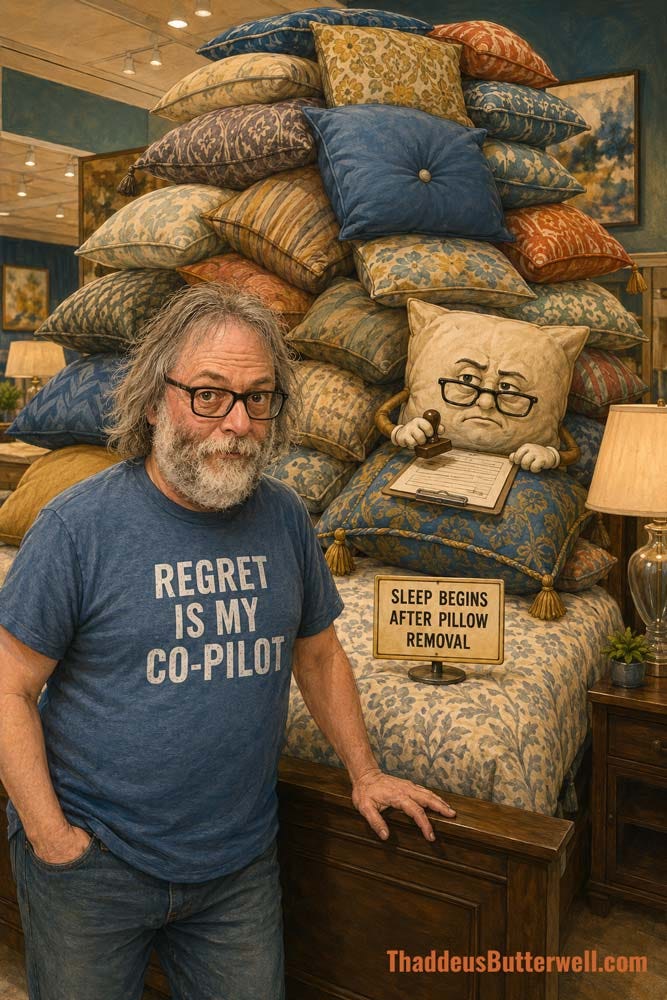
🛏️ Nine Pillows Means Sleep Has Become Administrative
Then I reached the bedroom displays.
Every bed had nine pillows.
Nine.
This suggests luxury is not comfort, but the ability to remove several decorative obstacles before becoming unconscious.
I stood before one bed arranged with such precision it seemed less like a sleeping place and more like a shrine to a couple who communicates exclusively through linen choices.
There were square pillows.
Long pillows.
Tiny pillows.
One pillow whose only purpose seemed to be making the other pillows feel successful.
I thought of my own bed at home, which usually contains one tired pillow, one suspicious blanket, and a shirt I might wear again if society lowers its standards by Wednesday.
The showroom bed said, “Rest here.”
My actual bed says, “Move the laundry first.”
And perhaps that is the more honest invitation.

🍽️ The Dining Sets Had Expectations
The dining room section was worse.
Every table looked like it was waiting for a family announcement.
One long wooden table had eight chairs, all arranged with the quiet menace of people about to discuss inheritance.
I sat in one of them and immediately felt I should apologize for something I had not yet done.
There were place settings.
Napkins folded into shapes that implied emotional competence.
A centerpiece made of sticks.
I do not understand centerpieces made of sticks.
Outside, sticks are debris.
Inside, sticks are taste.
This is how class works.
I imagined myself owning this dining set. Inviting people over. Serving something roasted. Saying, “Who wants coffee?” while secretly wondering if anyone noticed the chair in the bedroom holding seventeen unfolded T-shirts and one belt from a former era of confidence.
A dining table promises togetherness.
But it also asks follow-up questions.
Who will sit here?
What will you say?
Will you finally learn how to make salad dressing, or will you continue shaking bottled vinaigrette like it owes you money?
I left the table before it could ask about my five-year plan.
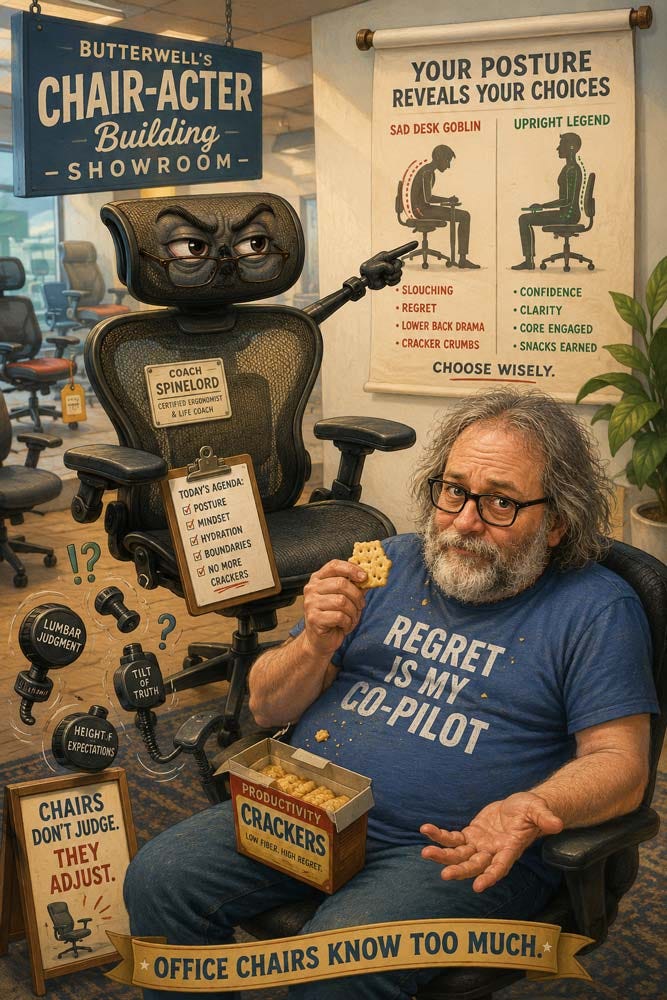
🪑 Office Chairs Know Too Much
The office chair section was where backs went to be judged.
Mesh backs.
Adjustable arms.
Lumbar support.
Little levers everywhere, as if productivity might be unlocked by lowering your left elbow one inch.
I sat in one chair and briefly became a man who answers emails promptly.
Horrifying.
Another chair made me feel like I owned a startup that sells accountability to people who already have calendars.
One chair was so ergonomic I felt accused by it.
It corrected my posture before I even had a thought.
I do not want a chair that believes in me that much.
I want a chair that understands me: sometimes upright, often folded, and not fully available until coffee has entered the negotiations.
🟫 The Beige Sectional Required a Family Meeting
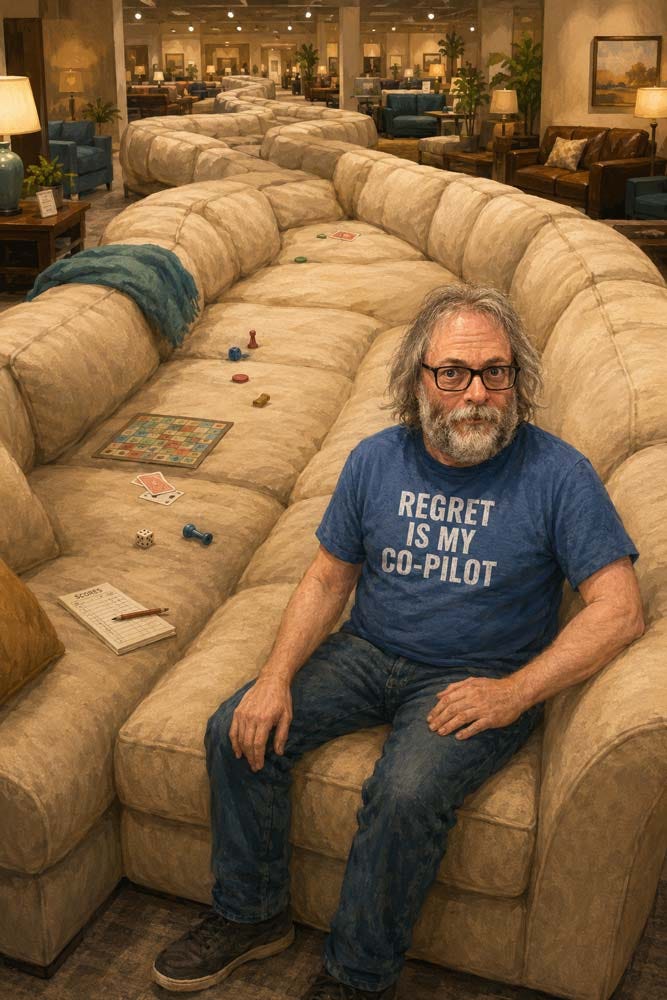
Near the back of the store stood an enormous beige sectional.
It was not furniture.
It was a region.
It stretched across the showroom floor like a beige continent. Somewhere on it, a family had probably gone missing during a board game.
I sat on one corner and felt very far away from myself.
This couch did not want one person.
It wanted a household.
It wanted snacks in matching bowls.
It wanted someone to say, “Let’s all talk about what happened.”
It wanted throw blankets and blended families and a dog with opinions.
It felt like a couch where people say, “We need to talk,” and then no one knows where to sit.
I sat there for several minutes, wondering if comfort always comes with implied witnesses.
Then I noticed a small sign.
Fabric protection available.
Of course.
Even the couch knew disaster was coming.

☕ A Room Without Spilled Coffee Is Not a Room Yet
After an hour, I became suspicious of the entire building.
Every fake room was too complete.
Every blanket was folded.
Every mug was empty.
Every side table had one tasteful object and no unpaid bill hiding under it.
No crumbs.
No dents.
No charging cord stretched across the floor where it could trip a relative.
No chair holding laundry.
No evidence that anyone had ever walked into the room holding a sandwich and a vague sense of dread.
That is when I realized furniture stores are museums of unlived lives.
They show us the fantasy version of domestic peace: clean lines, balanced colors, obedient pillows, lemons without responsibility.
But real life is not staged.
Real life has a screwdriver in the junk drawer that may or may not belong to you.
Real life has one chair everyone knows is not for sitting because it is currently storing laundry in the transitional state between “clean” and “accepted.”
Real life has a couch cushion permanently shaped by the person who claims they “barely sit there.”
Real life has crumbs.
And crumbs, as I have often said while brushing them off my shirt and calling it insight, are proof of participation.

🧺 Comfort Is Where the Mess Recognizes You
I did eventually find a chair.
Not the most impressive one.
Not the one with climate control, cup holders, and a control panel that looked like it could launch emotional satellites.
Just a chair.
A good chair.
A chair with reasonable arms and no grand claims.
It did not promise to transform me.
It did not imply I would start reading hardcover biographies or develop a wine vocabulary.
It simply said, “You may sit here and continue being whatever this is.”
That felt honest.
That felt useful.
That felt like the kind of comfort I could trust.
Because the goal is not to build a display life.
The trick is to make a place where you can set something down and find it again, eventually, probably under a catalog, near the crackers.
A showroom says, “Look how perfect this could be.”
A home says, “Careful, there’s a stain there, but we know its history.”
And that is not failure.
That is belonging.
🧂 Crumb of Meaning
Do not confuse display-life with real-life.
A life you actually live in will have dents, crumbs, mismatched blankets, and one chair quietly serving as a laundry annex.
Comfort is not the absence of mess.
Comfort is finding a place where the mess recognizes you and says, “Ah. You again.”
🤖 Disclaimer:
This advice was generated with the assistance of artificial intelligence and one man’s deeply suspicious relationship with decorative lemons. No recliners were harmed, though several were emotionally interrogated.
🍽️ Serving Suggestion:
Best consumed while sitting in the chair you meant to clean off three days ago.
If you don’t know by now that you should buy the t-shirt, I don’t know what to tell you.
Check out the Thaddeus J. Butterwell line of merch!

Coming Soon!
The book you didn’t know you needed… because denial is one of your core coping skills.
The astute among you may notice the cover has slightly changed.