🔮 Butterwell and the Mirror That Got Too Honest (#348)
Self-awareness is useful until it starts making eye contact.

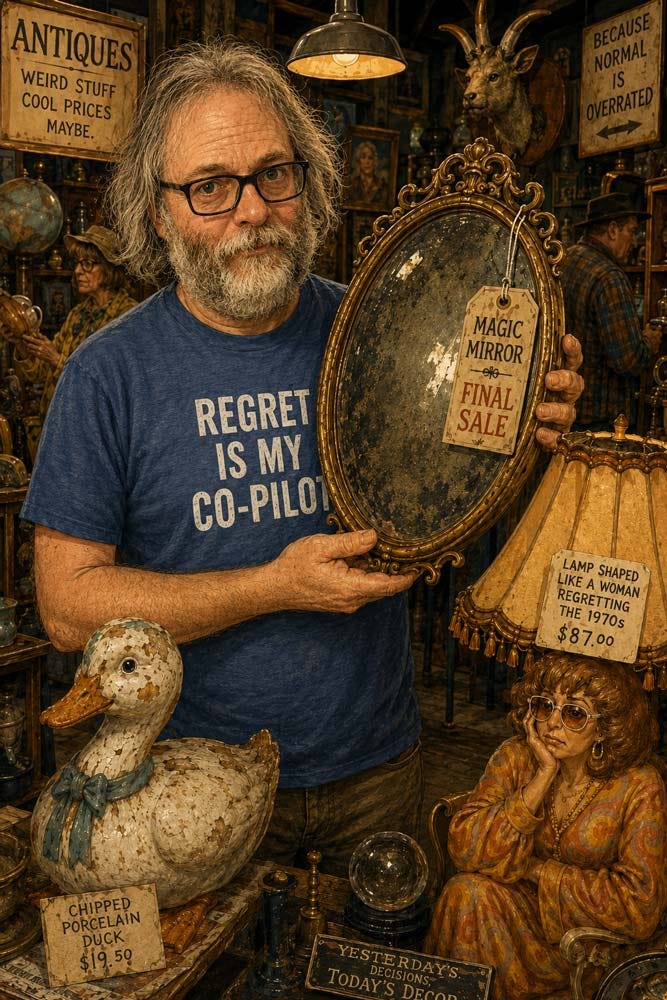
I found the mirror in the back of an antique shop between a chipped porcelain duck and a lamp shaped like a woman regretting the 1970s.
It was oval. Ornate. Slightly tarnished. The kind of mirror that looked like it had watched generations of people make poor hat decisions and said nothing.
A small tag hung from the frame:
MAGIC MIRROR — FINAL SALE
This should have concerned me.
Nothing good is final sale except soup after you have already paid for it.
Still, I bought it.
Not because I wanted a magic mirror. I already own a regular mirror, and frankly, that one has been aggressive enough.
I bought it because it was discounted, and discount is the language fate uses when it wants you to ignore warning signs.
💰 The Question Was Poorly Chosen
In the old fairy tale, the queen asks the mirror who is the fairest of them all.
This is a terrible question.
It is vain, insecure, and structurally doomed to end in either murder or skincare.
I did not ask that.
I am not interested in being the fairest. At this stage of life, fairness feels administratively out of reach. I would settle for clean, upright, and not visibly eating something from my beard.
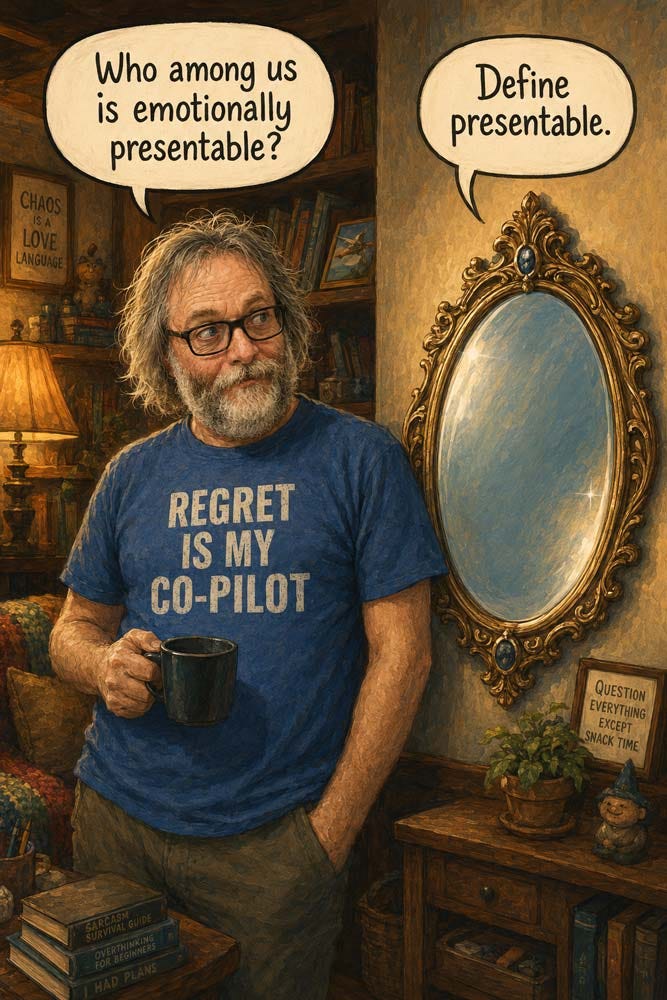
So I stood before the mirror in my REGRET IS MY CO-PILOT shirt, adjusted my glasses, and asked a more practical question:
“Who among us is emotionally presentable?”
The mirror paused.
Too long.
There are pauses that mean wisdom is gathering.
There are pauses that mean the waiter forgot your order.
And there are pauses that mean an enchanted object is trying to decide how badly you need to hear the truth.
This was the third kind.
Finally, the mirror said:
“Define presentable.”
I sat down.
Never begin self-reflection with a follow-up question from furniture.
👑 The Mirror Had Notes
The mirror did not shout.
That was the worst part.
Cruelty is easier when it is loud. You can dismiss it. You can say, “Clearly this mirror has unresolved issues.” You can cover it with a sheet and call a priest, or at least a contractor.
But this mirror spoke calmly.
Like a doctor reviewing lab results.
Like a manager saying, “We just have a few areas of opportunity.”
Like a dentist who already knows you have been lying about flossing.
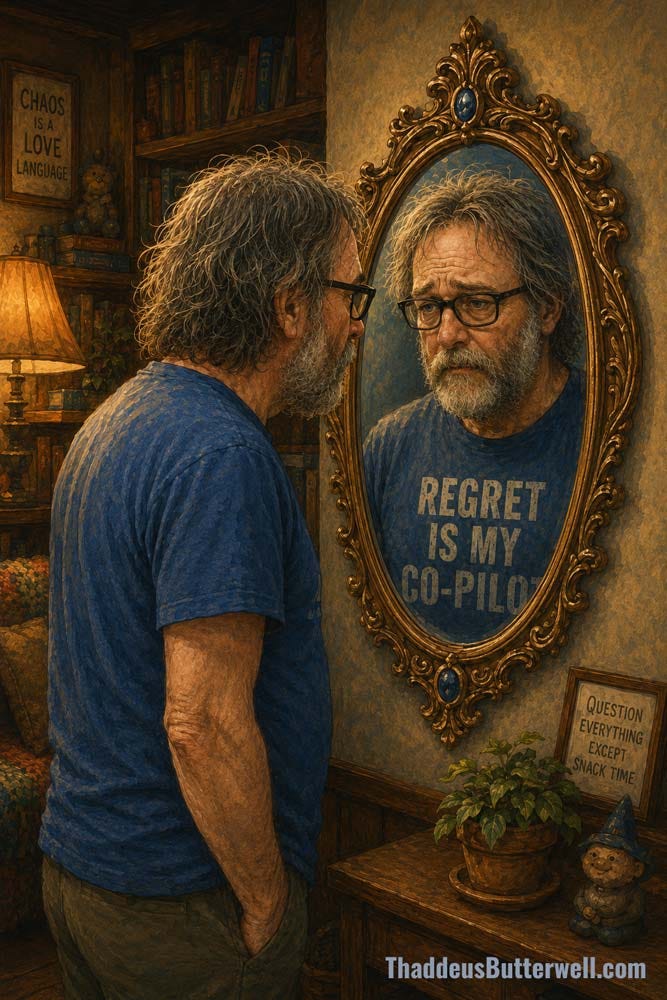
“You are not aging badly,” the mirror said.
I relaxed slightly.
“You are simply becoming increasingly specific.”
I did not know what to do with that.
Increasingly specific.
That is not an insult exactly.
It is more like being turned into a limited-edition condiment.
The mirror continued.
“You have reached the age where your face has become less of a face and more of a transcript.”
This was upsetting because it was accurate.
Every line had minutes attached.
Every wrinkle had a meeting agenda.
My forehead alone contained three childhood disappointments, two unpaid bills, and the expression I made in 1998 when someone said, “This will only take a second.”
The mirror was not judging me.
It was itemizing me.
🧴 Beauty Culture Is Just Fear With Better Packaging
The mirror said, “You are concerned with your appearance.”
“I am not,” I said.
“You bought beard oil called Woodland Authority.”
“That was aspirational.”
“You own under-eye cream.”
“It was on sale.”
“You once watched a video titled ‘How to Look Rested Without Becoming Rested.’”
I objected to this invasion of privacy, but only weakly, because I had watched that video twice.
Modern life has made vanity feel like maintenance.
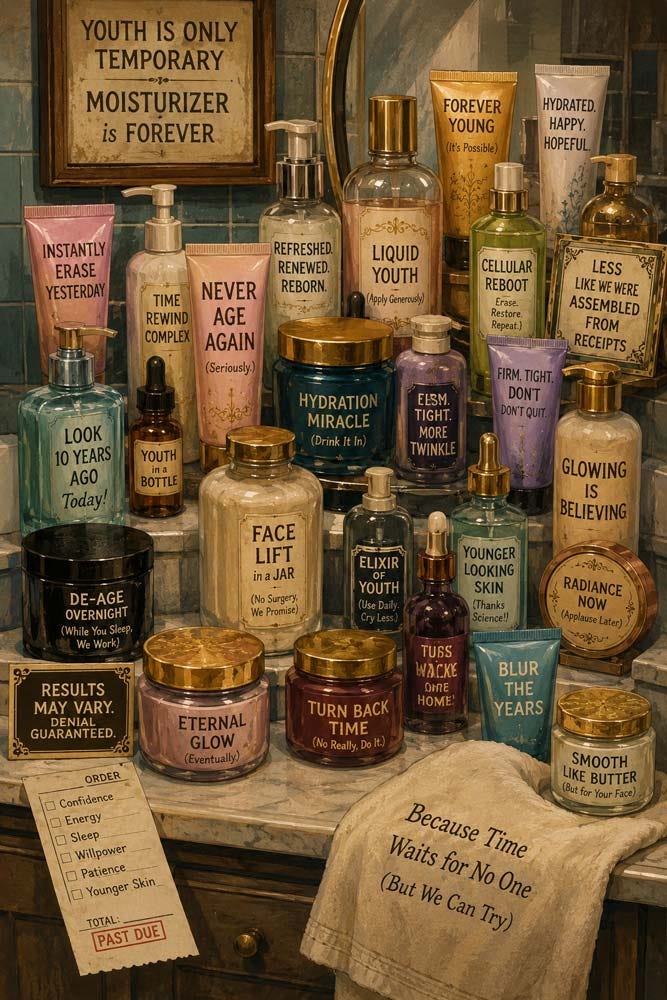
We are not supposed to say we want to look younger. That sounds shallow. So instead we say we want to look “refreshed,” “vital,” “hydrated,” “glowing,” or “less like we were assembled from receipts.”
Every bottle in the bathroom promises restoration.
Every label whispers, “You are not deteriorating. You are simply under-moisturized.”
This is how they get you.
They turn mortality into a subscription service.
There is a serum for texture. A serum for brightness. A serum for firmness. A serum for the abstract sadness near the left eye.
No one says, “This cream will not stop time, but it will give you something to rub into your face while panic thinks of a new outfit.”
I would buy that cream.
At least it would be honest.
🧺 I Tried to Cover the Mirror
Eventually I did what any emotionally mature philosopher would do.
I threw a towel over it.
The mirror was quiet for a moment.
Then it said, “That towel has been clean for six days and still has not been folded.”
This was unfair.
True, but unfair.
I removed the towel.
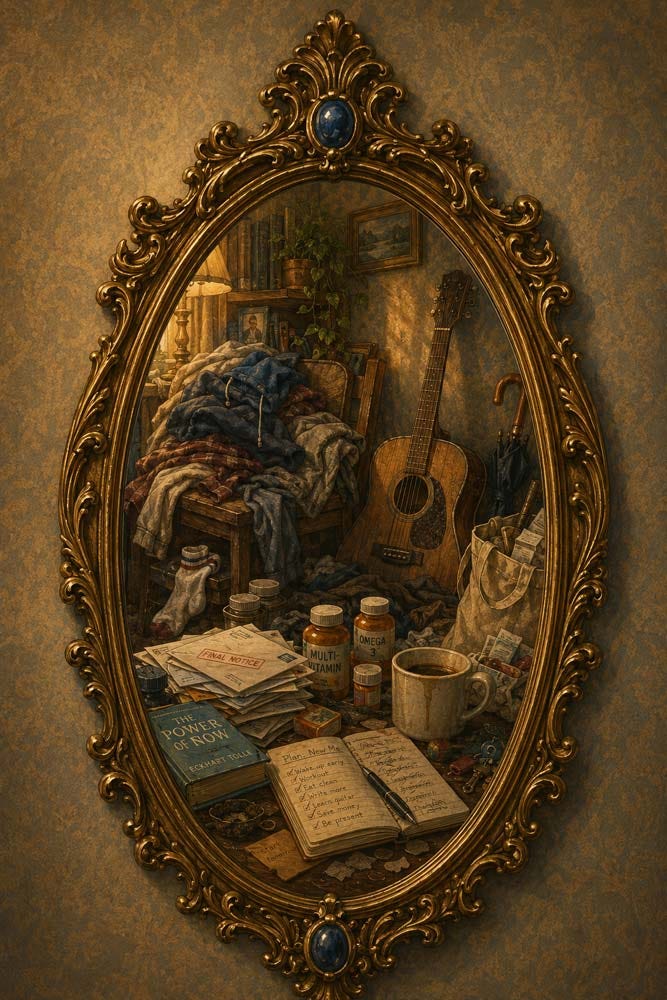
The mirror reflected me, the towel, the chair holding laundry, and a stack of books I had arranged to suggest intellectual momentum.
“You know,” I said, “most mirrors just reflect light.”
“Most people just avoid looking,” it replied.
That stung.
Not because it was clever.
Because it was boringly correct.
We are not afraid of mirrors because they show us our faces. Faces are manageable. You can tilt. You can squint. You can find better lighting. You can stand farther back and declare the problem solved.
We are afraid of mirrors because, on the wrong day, they catch the whole room.
The laundry chair.
The unopened mail.
The vitamins you bought during a health mood.
The guitar you were definitely going to learn.
The decorative bowl full of keys, coins, and tiny failures.
The mirror does not accuse.
It includes.
That is much worse.

🍎 The Queen Was Not Crazy, Just Over-Monitored
I began to feel sympathy for the queen.
Not approval. Let us be clear. Poisoning people because your mirror lacks customer-service skills is excessive.
But I understood the premise.
Imagine having a device in your home that constantly ranks you.
Absurd, yes?
Anyway, I checked my phone.
There it was.
Likes. Views. Followers. Comments. Step count. Sleep score. Screen time. Bank balance. Delivery status. Photo memories from a version of myself with better posture and fewer opinions about fiber.
We laugh at fairy-tale queens for asking mirrors to validate them.
Meanwhile, we carry little black mirrors in our pockets and ask them, all day long:
Am I liked?
Am I aging well?
Am I successful?
Am I behind?
Am I still invited?
Did anyone notice?
Do I exist enough today?
The queen had one magic mirror.
We have several, and some of them send notifications.
No wonder everyone is tired.

🪑 Emotional Presentability Is a Scam
The mirror asked, “Would you like the truth?”
“No,” I said. “I would like a manageable version of it with snacks.”
That, I believe, is what most of us want.
Not lies.
Not delusion.
Just the truth portioned correctly.
Nobody wants their entire self delivered at once. That is not growth. That is emotional catering gone wrong.
Give me one uncomfortable insight on a small plate.
Pair it with a cracker.
Do not wheel in the buffet of everything I have avoided since 1986.
The self-help industry talks about “doing the work,” as if the work is a clean, linear process involving journals, breathing, and a woman named Kendra who owns linen pants.
But real self-awareness is usually less elegant.
It is noticing you got defensive.
It is realizing the thing you mocked is the thing you want.
It is hearing yourself tell the same story again and suddenly understanding you are not explaining your life.
You are protecting the wound.
That is not a spa day.
That is finding a mushroom behind the refrigerator.
Useful?
Yes.
Lovely?
Absolutely not.

🧠 The Mirror’s Final Assessment
Before I moved the mirror to the hallway, where it could do less psychological damage, I asked one last question.
“Am I all right?”
The mirror waited.
Not dramatically this time.
Kindly.
Then it said:
“You are not polished. You are not finished. You are not especially graceful under direct observation. But you are still here, still asking, and still making tea after bad news. This counts.”
I did not like how much that helped.
Because we want self-knowledge to be clean. We want the truth to arrive wearing a robe, carrying a candle, perhaps speaking in a British accent.
But sometimes the truth is just this:
You are older than you were.
You are stranger than you planned.
You are carrying more than you admit.
And somehow, despite all available data, you remain eligible for breakfast.
That is not fairest.
But it is something.
🧂Crumb of Meaning:
Self-awareness is useful until it starts making eye contact.
Look long enough to learn something.
Then step away.
No one should stare into the truth before coffee.
🤖 Disclaimer:
This reflection was generated with help from artificial intelligence, one suspicious antique mirror, and a fictional professor who believes emotional growth should come with dimmer switches.
🍽️ Serving Suggestion:
Best consumed with tea, toast, and a towel nearby — not to hide from the truth, but to cover it briefly while you gather crackers.
If you don’t know by now that you should buy the t-shirt, I don’t know what to tell you.
Check out the Thaddeus J. Butterwell line of merch!

Coming Soon!
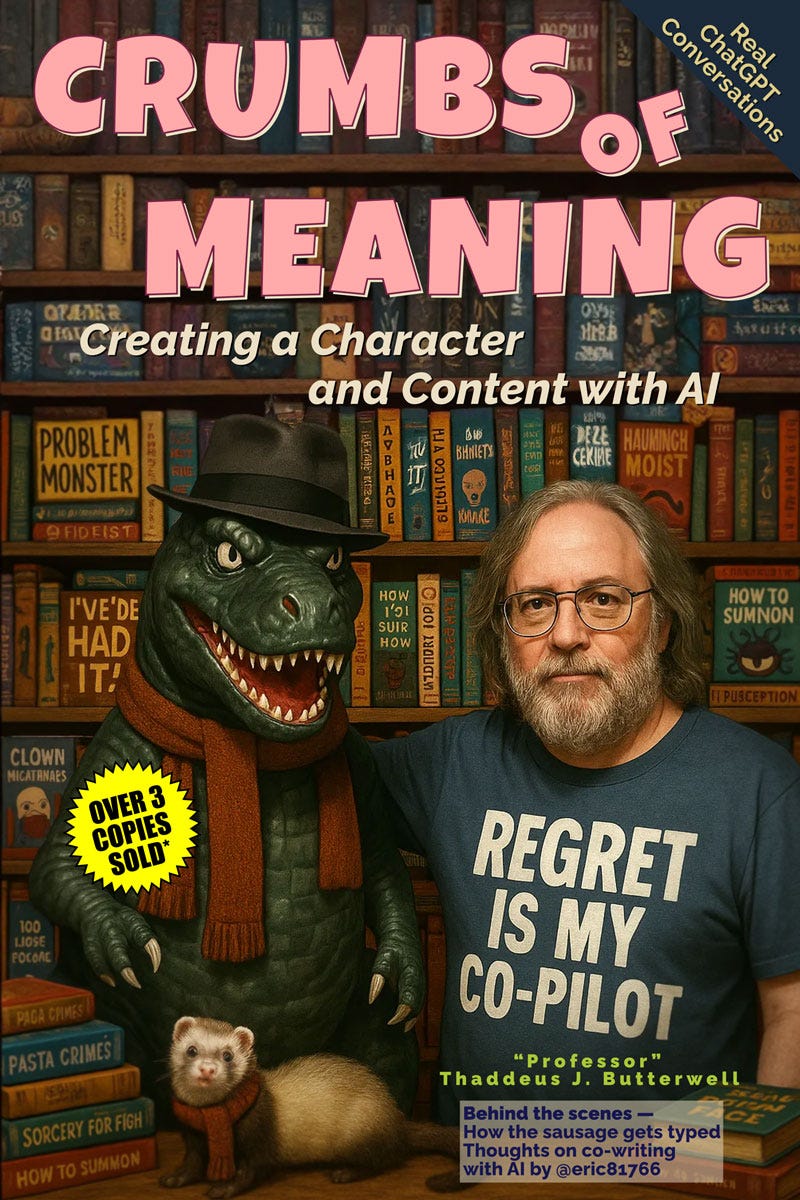
The book you didn’t know you needed… because denial is one of your core coping skills.
The astute among you may notice the cover has slightly changed.
BEHIND THE SCENES